
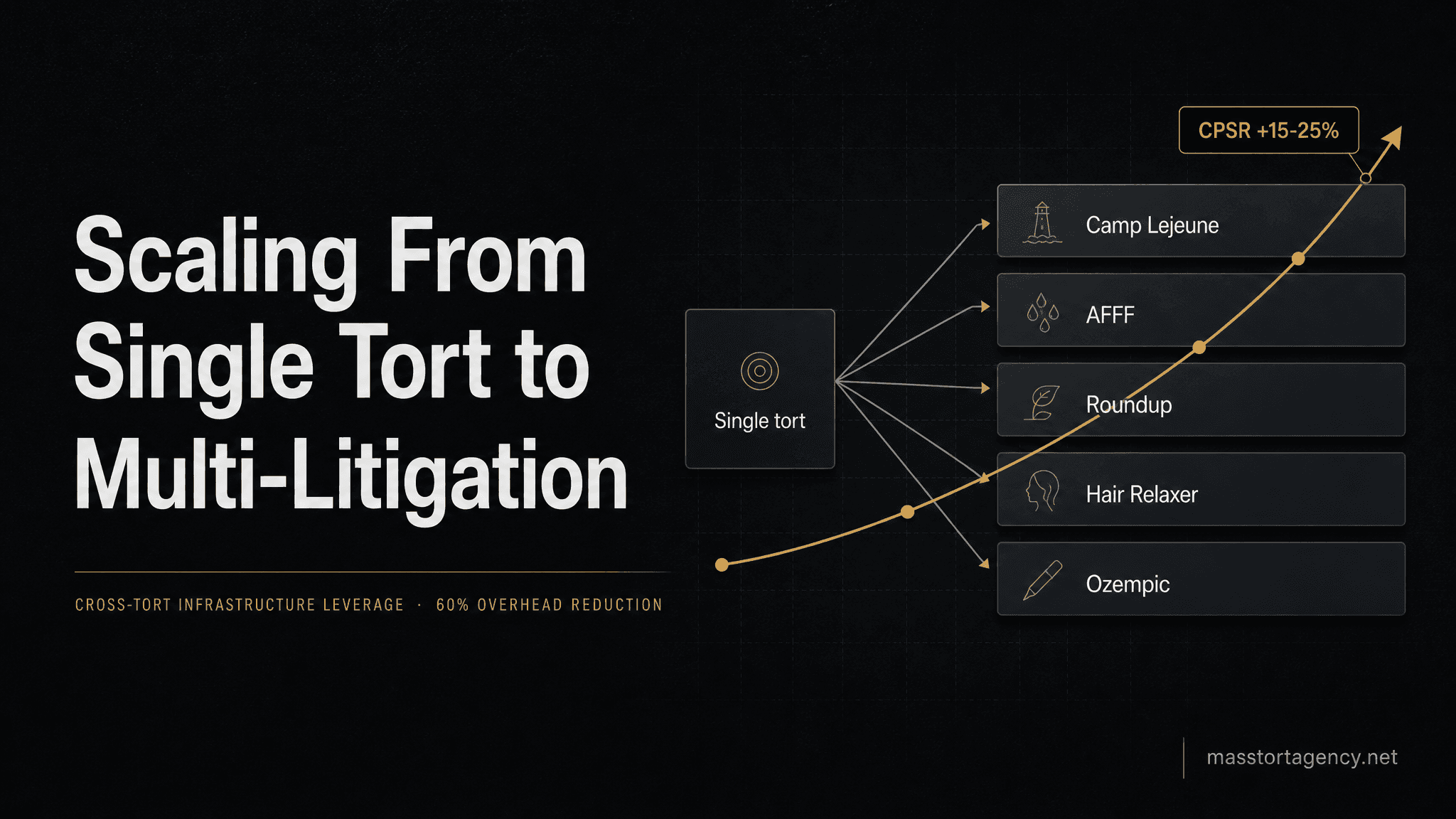
The single-tort trap and the case for diversification
Most PI firms enter mass torts through a single case type. Maybe it is Roundup because you had a client with non-Hodgkin lymphoma and a lawn care history. Maybe it is hernia mesh because a surgeon referral source mentioned complications. Whatever the entry point, the firm builds intake processes, marketing campaigns, and case knowledge around that one tort — and then stops.
This is the single-tort trap. It feels productive because cases are flowing and revenue is projected. But it exposes the firm to catastrophic risk: if the litigation fails (adverse ruling, defendant bankruptcy, or unfavorable settlement), years of investment evaporate. Even in the best scenario, a single tort eventually exhausts its plaintiff population, and the firm has no pipeline to replace the revenue.
The data is clear. Seventy-three percent of the top-revenue mass tort firms operate across three or more active torts. These multi-tort firms generate 3.6x more revenue per partner than single-tort firms of comparable size. They are not larger because they handle more torts — they handle more torts because diversification enables them to grow sustainably, weather litigation setbacks, and capture opportunities that single-tort firms cannot pursue.
A single-tort practice is a bet. A multi-tort practice is a business. The difference is not ambition — it is infrastructure, process, and disciplined execution.

Readiness assessment: are you ready for tort number two?
Not every firm that wants to scale is ready to scale. Premature expansion is the most common cause of failure in multi-tort practices. Before adding a second tort, evaluate your firm against five readiness criteria. If you cannot answer "yes" to at least four, you are not ready.
The five readiness criteria
- Profitable unit economics on tort one: Your cost per signed retainer is at or below your target, and your expected case value exceeds your total acquisition and carrying costs by at least 3x. If tort one is not yet profitable, scaling will multiply losses, not profits.
- Documented intake processes: Your qualification criteria, screening scripts, follow-up cadences, and retainer execution procedures are written down, not just in people's heads. A new team member could follow the documentation and achieve 80% of your current conversion rate within two weeks.
- Capacity in your intake team: Your current team is handling incoming leads without backlogs or quality degradation. If you are already missing leads or delaying follow-up on tort one, adding tort two will make both worse.
- Case management infrastructure: You have a CRM or case management system that can handle multiple tort types with different qualification criteria, document requirements, and litigation timelines. Spreadsheets do not scale.
- Financial runway: You have 12-18 months of operating capital available for the new tort's acquisition spend, assuming zero settlements during that period. Mass tort cash flow is lumpy — you need reserves to sustain acquisition through the dry periods.
Choosing your second tort: strategic selection criteria
Your second tort should complement your first — sharing enough operational overlap to leverage existing infrastructure while diversifying enough to reduce portfolio risk. The wrong second tort will strain your organization without reducing your exposure to single-tort failure.
Complementary tort pairings
The strongest second-tort choices share two of three characteristics with your first tort: similar plaintiff demographics, similar qualifying criteria structure, or similar litigation timeline. For example, if your first tort is Ozempic gastroparesis, a pharmaceutical tort targeting patients with medication-related injuries, strong complements include Depo-Provera meningioma (same category, different drug, different injury) or Risperdal gynecomastia (same category, different demographics).
Evaluating tort attractiveness
| Factor | Weight | What to evaluate |
|---|---|---|
| Settlement value | 25% | Expected average and range based on bellwether results or comparable torts |
| Plaintiff population | 20% | Total addressable market and remaining unretained plaintiffs |
| Acquisition cost | 20% | Current cost per signed retainer and trend direction |
| Litigation momentum | 20% | MDL status, key rulings, bellwether trial schedule, settlement talks |
| Operational fit | 15% | Overlap with existing intake criteria, demographics, and case management workflows |
Avoiding correlated risks
Diversification only works if your torts are not correlated. Two pharmaceutical torts with the same defendant share bankruptcy risk. Two environmental torts in the same jurisdiction share judicial risk. Two torts relying on the same scientific theory share causation risk. Build your portfolio across defendants, jurisdictions, injury types, and scientific bases. As we covered in our ROI maximization guide, uncorrelated torts are the foundation of sustainable revenue.
Building your multi-tort portfolio?
Mass Tort Agency offers leads across 15+ active tort categories. Start with a single tort and scale at your pace — we provide the acquisition infrastructure so you can focus on litigation.
Explore All Tort CategoriesInfrastructure requirements for multi-tort operations
Scaling from one tort to several requires infrastructure investments that single-tort practices can defer. These investments are the difference between controlled growth and chaotic expansion. Each system compounds in value as you add torts — the second tort costs significantly less to launch than the first because the infrastructure is already in place.
CRM and lead management
Your CRM must handle leads from multiple tort types with different qualification criteria, different follow-up sequences, and different conversion timelines. It must support cross-qualification — when a lead does not qualify for the target tort, the system should automatically screen against all other active torts. Platforms like Salesforce, HubSpot, or legal-specific solutions like Litify and Filevine support multi-tort workflows. Budget $500-$2,000/month depending on firm size and feature requirements.
Case management
Mass tort case management differs fundamentally from single-event PI case management. You are tracking hundreds or thousands of cases with shared litigation timelines, common discovery deadlines, and coordinated settlement processes. Dedicated mass tort case management platforms automate document collection, statute of limitations tracking, medical records organization, census reporting for MDL committees, and settlement administration. Without this technology, scaling beyond 200-300 cases becomes operationally unsustainable.
Communication systems
Multi-tort practices need phone systems with skill-based routing (directing calls about Ozempic to agents trained on Ozempic), multi-line call tracking (separate numbers per tort per advertising channel for attribution), SMS and email automation (different nurture sequences per tort), and multilingual capabilities. Cloud-based phone systems like RingCentral or Five9 with legal integrations provide these features at $50-$150 per seat per month.
Staffing models that scale
The staffing model that works for a single-tort practice rarely works for a multi-tort practice. Single-tort firms can operate with generalists who know one set of qualifying criteria deeply. Multi-tort firms need a structured staffing model that balances specialization with flexibility.
The tiered intake model
The most successful multi-tort firms use a three-tier intake structure. Tier 1: Initial screening agents handle first-contact calls and form submissions across all torts. They are trained on basic qualification criteria for every active tort and route qualified leads to the appropriate specialist. Tier 1 agents are typically hired at $18-$25/hour and trained in 1-2 weeks.
Tier 2: Tort-specific paralegals conduct in-depth qualification including medical records review, exposure verification, and detailed criteria screening. Each paralegal specializes in 2-3 torts. They convert qualified leads into signed retainers. Paralegals cost $55,000-$85,000/year and require 4-6 weeks of tort-specific training.
Tier 3: Case management attorneys oversee filed cases, coordinate with co-counsel and MDL committees, and manage client relationships through resolution. Each attorney handles 200-500 cases depending on tort complexity and case stage. Associate attorneys cost $80,000-$150,000/year in most markets.
Initial screening agents
First-contact handling across all torts. Trained on basic qualification. Routes leads to specialists. 1-2 week ramp. $18-$25/hr.
Tort-specific paralegals
In-depth qualification, medical records review, retainer execution. Specializes in 2-3 torts. 4-6 week training. $55K-$85K/yr.
Case management attorneys
Filed case oversight, MDL coordination, client management. Handles 200-500 cases per tort. $80K-$150K/yr.
Data & operations analyst
Tracks conversion metrics, manages vendor reporting, maintains dashboards, identifies optimization opportunities. $65K-$95K/yr.
Marketing coordinator
Manages vendor relationships, monitors ad performance, coordinates creative development, ensures compliance. $50K-$75K/yr.
Bilingual intake specialist
Spanish-language screening and qualification. Handles leads from bilingual campaigns. 2-3 week ramp. $22-$30/hr.

Financial planning for multi-tort growth
The financial profile of a multi-tort practice is fundamentally different from a single-tort practice. Revenue is lumpier, capital requirements are higher, and cash flow management is more complex. Firms that scale without adequate financial planning often succeed operationally while failing financially — they sign thousands of cases but run out of cash before settlements arrive.
Cash flow modeling
Mass tort settlements arrive in waves, not streams. A firm may receive zero settlement revenue for 18-24 months after launching a new tort, then receive a large disbursement when a global settlement is reached or bellwether results trigger a resolution program. Model your cash flow conservatively: assume settlement timelines will be 6-12 months longer than projected, and budget accordingly.
Working capital requirements
For each new tort, budget the following monthly costs for the first 18 months: lead acquisition ($10,000-$50,000), screening and intake ($3,000-$10,000), case management ($2,000-$5,000), and administrative overhead ($1,000-$3,000). Total monthly burn rate per tort: $16,000-$68,000. Over 18 months, each tort requires $288,000-$1.2M in working capital before the first settlement dollar arrives.
| Cost Category | Monthly (Low) | Monthly (High) | 18-Month Total |
|---|---|---|---|
| Lead acquisition | $10,000 | $50,000 | $180K – $900K |
| Screening & intake | $3,000 | $10,000 | $54K – $180K |
| Case management | $2,000 | $5,000 | $36K – $90K |
| Administrative overhead | $1,000 | $3,000 | $18K – $54K |
Litigation financing options
Pre-settlement litigation financing provides capital to fund case acquisition and carrying costs, repaid from future settlement proceeds. Typical terms: 15-30% annual cost of capital, non-recourse (you repay only from settlement proceeds), with funding available within 2-4 weeks. Litigation financing is not cheap, but it enables firms to scale faster than internal cash flow would allow. The key calculation: does the marginal revenue from additional cases exceed the financing cost? If yes, finance. If no, wait.
Scale your mass tort practice with confidence
Mass Tort Agency provides exclusive leads across 15+ tort categories with transparent pricing, real-time reporting, and flexible volume commitments. Scale up or down as your portfolio evolves.
Start Your CampaignVendor management across a multi-tort portfolio
As you scale to multiple torts, the number of external vendors in your operation multiplies. Lead generation vendors, screening services, medical records providers, co-counsel networks, litigation funding companies, case management software providers, and advertising agencies all need coordination. Without centralized vendor management, costs rise, quality drops, and compliance gaps emerge.
Vendor selection framework
Evaluate every vendor on four dimensions: quality (measured by the downstream metrics they impact, not vanity metrics they report), compliance (TCPA compliance, state bar advertising rule adherence, data security practices), scalability (can they grow with you as you add volume and torts?), and integration (do their systems connect to your CRM and case management platform?). Score vendors quarterly and replace the bottom 10% annually.
Avoiding vendor dependency
Never source more than 50% of your leads for any tort from a single vendor. Vendor dependency creates pricing leverage against you, quality risk if the vendor's performance degrades, and supply risk if the vendor loses compliance or goes out of business. Maintain at least two qualified vendors per tort, with the secondary vendor receiving enough volume to maintain performance data and relationship strength. This mirrors the diversification principles driving the broader market.
Intake systems that handle multiple qualification criteria
The operational core of a multi-tort practice is the intake system. Every tort has different qualifying criteria — different medications, different devices, different exposure requirements, different injuries, different statutes of limitations. Your intake system must manage this complexity without requiring your agents to memorize everything or your attorneys to screen every lead.
Dynamic qualification scripts
Build modular qualification scripts that branch based on tort type. When a lead comes in tagged for a specific tort, the intake system presents the appropriate screening questions. If the lead fails qualification for the tagged tort, the system automatically pivots to cross-qualification against all other active torts. The agent follows the script; the system handles the logic.
Automated document collection
Each tort requires different documentation: pharmaceutical torts need prescription records, medical device torts need surgical records, environmental torts need residence or employment verification. Automate document collection by sending tort-specific request packages immediately after retainer signing. Use digital portals where clients can upload documents directly, reducing mail delays and lost paperwork. Automated reminders at 3, 7, and 14 days ensure document completion rates above 80%.

Risk diversification: building a resilient practice
Risk diversification is the primary strategic rationale for multi-tort practices. Every mass tort carries litigation risk, and even strong cases can produce disappointing outcomes. A diversified portfolio protects your firm from any single adverse result.
Types of risk to diversify against
- Causation risk: Scientific evidence may not support the alleged link between product and injury. Diversify across torts with different causal theories.
- Defendant risk: Defendants may declare bankruptcy, limiting recoverable damages. Diversify across defendants and industries.
- Judicial risk: Unfavorable rulings by a specific judge can derail an entire MDL. Diversify across courts and jurisdictions.
- Market timing risk: Lead costs rise as torts mature and competition intensifies. Diversify across tort maturity stages — include early-stage torts with lower acquisition costs alongside mature torts with more predictable outcomes.
- Regulatory risk: Legislative changes can create or eliminate causes of action. The PACT Act created Camp Lejeune claims; future legislation could preempt other torts. Diversify across regulatory frameworks.
Portfolio stress testing
Quarterly, stress test your portfolio by answering: "What happens if our largest tort fails entirely?" If losing your biggest tort would threaten firm viability, you are overconcentrated. Reduce allocation to the dominant tort and redistribute to underweighted categories. The goal is a portfolio where no single tort represents more than 30-35% of expected revenue.
The 18-month scaling timeline
Based on the experience of hundreds of PI firms we work with, the typical scaling timeline from single-tort to multi-litigation practice follows a predictable 18-month arc. Firms that try to compress this timeline usually sacrifice quality. Firms that extend it unnecessarily lose first-mover advantage on emerging torts.
Months 1-3: foundation
Audit and document your existing tort one processes. Implement or upgrade your CRM. Evaluate and select case management technology. Develop financial projections for multi-tort operations. Research and score candidate torts for your second position. Interview and select lead generation vendors for tort two. This phase is preparation — resist the urge to start buying leads before the foundation is solid.
Months 4-6: launch tort two
Begin lead acquisition on tort two at conservative volume — 30-50% of your tort one volume. Train intake staff on new qualification criteria. Establish conversion benchmarks and track weekly. Identify and fix process bottlenecks. By month 6, tort two should be operating profitably at its initial volume level with a clear path to scale.
Months 7-12: optimize and prepare for tort three
Scale tort two to full volume as conversion benchmarks stabilize. Optimize cross-qualification between torts one and two. Begin research on tort three candidates. Hire additional intake and case management staff. Refine your vendor management processes. At month 12, you should have two profitable torts operating at scale and a clear plan for adding a third.
Months 13-18: expand the portfolio
Launch tort three. Apply the lessons from torts one and two to compress the ramp-up timeline. By month 18, you should have three active torts generating leads, signing cases, and building toward settlements — a true multi-tort practice with diversified revenue sources and proven scaling processes.
Case management technology for multi-tort operations
Case management technology is the single most important investment for multi-tort scaling. Without purpose-built mass tort case management, you are limited by the number of cases your team can track manually — and that ceiling is far lower than most firms realize.
Features that matter for mass tort case management
- Multi-tort case tracking: Manage cases across different torts with different criteria, timelines, and workflows in a single system.
- Automated deadline management: Statute of limitations, discovery deadlines, and MDL-specific dates tracked and alerted automatically.
- Medical records organization: Automated ingestion, OCR, and categorization of medical records. Critical for torts requiring proof of diagnosis, treatment, or prescription history.
- Census reporting: Generate MDL census reports and plaintiff fact sheets automatically, saving dozens of paralegal hours per reporting cycle.
- Client portal: Self-service portal where clients check case status, upload documents, and communicate with their legal team. Reduces inbound calls by 40-60%.
- Settlement administration: Calculate settlement allocations, generate disbursement documents, and track distributions when settlements close.
Building a sustainable multi-tort practice
The firms that thrive in mass torts are not the ones that grow fastest — they are the ones that grow most sustainably. Sustainable growth means every new tort is launched on a foundation of proven processes, adequate capital, and realistic expectations.
The playbook is straightforward even if the execution is demanding: master one tort before adding a second. Document everything. Invest in technology before you invest in volume. Hire ahead of demand for infrastructure roles (data analysts, operations managers) and behind demand for variable roles (intake agents, paralegals). Diversify across uncorrelated torts. Stress test your portfolio quarterly. Maintain financial reserves for dry periods.
The 18-month timeline works because it balances speed with quality. The firms that follow it consistently arrive at month 18 with a durable competitive advantage: a multi-tort practice that generates diversified revenue, attracts strong co-counsel relationships, and weathers individual litigation setbacks without existential risk. For specific guidance on optimizing the economics of your portfolio once built, reference our ROI maximization guide, and for the technology trends that will shape the next phase of growth, see our analysis of plaintiff acquisition trends.
