
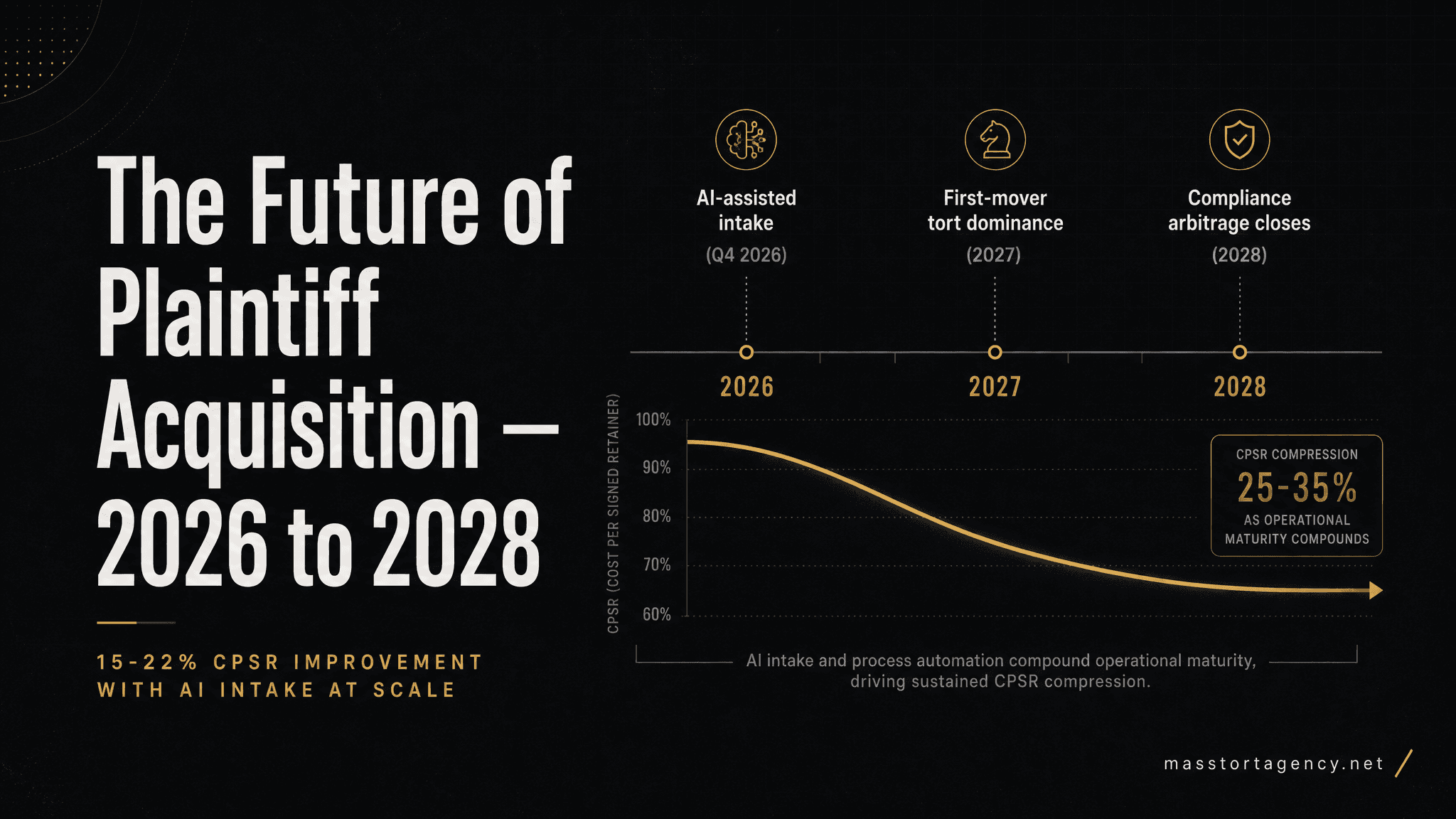
The plaintiff acquisition landscape is changing fast
Five years ago, mass tort plaintiff acquisition was relatively straightforward: buy television spots, run Google Ads, and wait for the phone to ring. The firms with the biggest budgets won the most cases. That model is dying. In its place, a more sophisticated, technology-driven, and data-intensive acquisition ecosystem is emerging — one that rewards precision over brute force and innovation over inertia.
Digital advertising spend in legal services has grown 340% since 2020, far outpacing overall digital ad growth. The mass tort advertising market alone now exceeds $2.1 billion annually. As more firms compete for the same plaintiff populations, the cost of acquisition rises and the margin for error shrinks. Firms that do not adapt to the new landscape will find themselves priced out of profitable torts within two to three years.
This article maps the major trends reshaping plaintiff acquisition in 2026 and beyond. Each section identifies a specific shift, explains why it matters, and provides actionable steps PI firms can take today to stay ahead of the curve.
The future of plaintiff acquisition belongs to firms that treat technology as a competitive advantage, not a cost center. The gap between early adopters and laggards is widening every quarter.

AI-powered intake: the 24/7 qualification engine
Artificial intelligence is transforming the intake process from a bottleneck into a competitive advantage. Traditional intake requires human agents available during business hours, creating a 14-16 hour daily window where leads go unanswered. AI-powered intake systems operate around the clock, qualifying leads in real time via conversational interfaces that are indistinguishable from human agents in many scenarios.
How AI intake works in practice
Modern AI intake systems use large language models fine-tuned on legal qualification criteria. When a lead calls or submits a form at 2 AM, the AI system engages immediately — asking screening questions specific to the tort, verifying exposure timelines, confirming injury diagnoses, and checking for prior representation. Leads that pass qualification are flagged for attorney follow-up in the morning. Leads that fail are documented and, critically, cross-screened against other active torts before being released.
The best systems integrate with medical records databases to verify diagnoses in real time, cross-reference prescription histories against pharmaceutical tort criteria, and flag leads with characteristics that predict high case value. This is not science fiction — firms deploying AI intake today report 35-50% reductions in cost per qualified lead and 20-30% improvements in speed-to-contact.
Implementation considerations
AI intake systems require initial setup investment of $10,000-$50,000 depending on complexity, plus $2,000-$8,000/month in operational costs. ROI typically breaks even within 3-6 months. Key selection criteria: compliance with state bar advertising rules, HIPAA compliance for health data handling, ability to customize qualification scripts by tort, and integration with your existing CRM.
Programmatic advertising: precision targeting at scale
Programmatic advertising — the automated buying and placement of digital ads in real time — is rapidly displacing manual media buying in legal advertising. Programmatic platforms use data-driven algorithms to place your ads in front of the specific audiences most likely to qualify for your active torts, across thousands of websites and apps simultaneously.
Data segments that power legal programmatic
The power of programmatic lies in its targeting precision. Legal advertisers can access anonymized data segments including: prescription histories (targeting users prescribed specific medications relevant to pharmaceutical torts like Ozempic or Depo-Provera), geographic proximity to contamination sites (relevant to Camp Lejeune or PFAS cases), occupation data (critical for AFFF firefighting foam cases), and health condition indicators.
A firm running an hair relaxer campaign can target women aged 25-65 who have purchased chemical hair straightening products and live in states with favorable statute of limitations provisions. This level of precision is impossible with traditional media buying, and it dramatically reduces wasted impressions.
Programmatic performance benchmarks
| Metric | Search Ads | Social Ads | Programmatic |
|---|---|---|---|
| Avg CPM | $45 – $120 | $12 – $35 | $8 – $25 |
| Avg CTR | 3.2% – 8.5% | 0.8% – 2.1% | 0.3% – 0.9% |
| Avg Cost/Lead | $150 – $450 | $75 – $250 | $60 – $200 |
| Lead Quality | High intent | Medium intent | Variable |
| Scale Ceiling | Limited by volume | High | Very high |
Stay ahead of the plaintiff acquisition curve
Mass Tort Agency combines cutting-edge targeting technology with decades of legal marketing expertise. Get exclusive, pre-qualified leads delivered to your intake team.
Explore Lead CategoriesCTV and OTT: television meets digital precision
Connected television (CTV) and over-the-top (OTT) platforms represent the most significant shift in legal advertising since Google Ads. These channels deliver television-quality creative — the emotional storytelling that drives mass tort awareness — with the targeting and measurement capabilities of digital advertising.
Why CTV matters for mass torts
Traditional TV is a blunt instrument. You buy a DMA, pick a daypart, and hope your audience is watching. CTV lets you target specific households based on demographic, behavioral, and interest data. A firm running hernia mesh campaigns can serve ads exclusively to viewers aged 45-75 who have shown interest in medical malpractice or surgical complications. No wasted impressions on 25-year-olds who have never had surgery.
CTV also solves the attribution problem that has plagued TV advertising for decades. When a viewer sees your CTV ad and later visits your website or calls your number, the conversion can be tracked and attributed to the specific ad impression. This transforms TV from a "brand awareness" cost center into a measurable, optimizable performance channel.
CTV cost structure and performance
CTV CPMs range from $25-$45 for legal targeting — significantly lower than linear TV CPMs of $40-$80 in comparable DMAs. Completion rates (viewers watching the full 30-second spot) average 95% on CTV versus 70% on linear TV. The higher completion rate compensates for lower reach, and the targeting precision means every completed view is more valuable.
The mobile-first plaintiff: redesigning the intake journey
Forty-seven percent of all mass tort leads now originate from mobile devices. For torts targeting younger demographics — NEC baby formula (parents of premature infants), hair relaxer (women aged 25-55) — mobile share exceeds 60%. Yet most PI firms still design their intake processes for desktop users making phone calls during business hours.
Mobile-optimized intake essentials
- Click-to-call buttons above the fold on every landing page. Mobile users convert 3x more often via phone than via form submission.
- SMS-based qualification — text message screening flows that let prospects qualify at their convenience. Response rates are 4-5x higher than email.
- Mobile-first landing pages that load in under 2 seconds on 4G connections. Every second of load time above 3 seconds reduces conversion by 20%.
- Tap-to-schedule callbacks that let mobile users book an intake call in 2 taps instead of navigating a form.
- Progressive web apps for complex qualification flows that require document uploads or medical record reviews.

First-party data strategies: owning your audience
Third-party cookies are disappearing. Third-party data segments face increasing regulatory scrutiny. The firms that will thrive in the next five years are the ones building first-party data assets today — owned audiences that they can target, retarget, and expand without depending on data providers that may not exist tomorrow.
Building a first-party data engine
First-party data comes from direct interactions with your firm: website visits, form submissions, email subscriptions, content downloads, webinar attendance, and intake interactions. Every person who visits your mass tort landing page and does not convert is a data asset if you capture their information with proper consent.
Build email lists segmented by tort interest. A visitor who reads your Roundup page but does not submit a form should enter a Roundup-specific email nurture sequence. When they are ready — when their diagnosis worsens, when they see a news story about a settlement, when a family member encourages them to call — your firm is top of mind. This is exactly how the highest-ROI firms operate.
Lookalike audiences from conversion data
Your signed retainer data is your most valuable targeting asset. Upload anonymized conversion data to advertising platforms to build lookalike audiences — algorithmic models that find new prospects who resemble your best-converting clients. Lookalike audiences from first-party conversion data consistently outperform third-party data segments, producing 20-40% lower cost per qualified lead and 15-25% higher signed retainer rates.
Privacy regulation: navigating the compliance landscape
The regulatory environment for legal advertising and lead generation is tightening. PI firms must navigate an increasingly complex web of federal, state, and industry-specific regulations — and the penalties for violations are severe.
Key regulations impacting plaintiff acquisition
TCPA compliance
Telephone Consumer Protection Act governs all calls and texts to potential plaintiffs. Prior express written consent required for autodialed calls and texts. Violations: $500-$1,500 per call/text.
State bar advertising rules
Each state imposes specific requirements on attorney advertising — disclaimers, disclosures, filing requirements, and content restrictions. Rules vary dramatically by jurisdiction.
CCPA/state privacy laws
California Consumer Privacy Act and expanding state equivalents regulate collection and use of personal data. Health data receives heightened protection. Opt-out rights must be honored.
HIPAA considerations
When screening involves medical records or health information, HIPAA compliance is required. Business associate agreements, encryption, and access controls are mandatory.
FTC advertising standards
Federal Trade Commission prohibits deceptive advertising. Claims about settlement values, case outcomes, or lead quality must be substantiated. Testimonials require disclaimers.
AI disclosure requirements
Emerging regulations in multiple states require disclosure when AI systems interact with consumers. AI-powered intake calls may need to identify themselves as automated systems.
Bilingual outreach: the underserved market opportunity
Hispanic and Latino communities represent the fastest-growing underserved market in mass tort litigation. Over 62 million Hispanic Americans face the same product exposures, environmental hazards, and medical device risks as the general population — but they are significantly less likely to pursue legal claims due to language barriers, cultural factors, and lack of targeted outreach.
Torts with high bilingual demand
Agricultural chemical exposure torts show the strongest bilingual demand. Roundup weedkiller and Dacthal herbicide cases disproportionately affect agricultural workers, a population that is over 75% Hispanic in many states. AFFF firefighting foam litigation also benefits from bilingual outreach, as Hispanic firefighters and military personnel were exposed at the same rates as their English-speaking colleagues.
Building bilingual intake capabilities
Effective bilingual outreach requires more than translating existing materials. It requires culturally adapted creative, native-speaker intake agents, Spanish-language landing pages optimized for search terms used by Spanish-speaking populations (which differ from direct translations of English keywords), and community-based marketing through Hispanic media outlets, churches, and community organizations. Firms that invest in genuine bilingual capabilities — not machine-translated afterthoughts — report 30-40% lower cost per lead with equivalent or superior conversion rates.
Future-proof your plaintiff acquisition strategy
Mass Tort Agency leverages programmatic targeting, AI-powered screening, and multi-channel attribution to deliver the highest-quality leads in the industry.
Start Your CampaignPredictive analytics: forecasting before you spend
Predictive analytics transforms mass tort lead generation from a reactive spend-and-measure cycle into a proactive forecast-and-deploy strategy. By analyzing historical patterns in lead flow, conversion rates, and external signals, firms can anticipate changes in the market weeks or months before they are visible in raw performance data.
What predictive models can forecast
- Lead volume by tort: Search trend data, news coverage volume, and social media mentions predict lead volume 2-4 weeks in advance. Firms that scale spend ahead of volume spikes capture leads at lower CPAs.
- Conversion probability by lead: Demographic, geographic, and behavioral features predict which leads are most likely to sign retainers. Scoring leads at intake allows firms to prioritize follow-up on high-probability prospects.
- Cost-per-lead trajectory: Competitive intelligence and auction data predict when CPCs and CPMs will rise. Firms that lock in spend commitments before cost increases protect their margins.
- Case value estimation: Injury severity, jurisdiction, and defendant financial condition predict settlement values. This enables firms to set appropriate acquisition cost ceilings by lead.

Social media evolution: from awareness to conversion
Social media's role in plaintiff acquisition is evolving rapidly. Facebook remains the highest-volume social channel for mass tort leads, but its effectiveness is shifting from direct-response advertising toward awareness and retargeting. Meanwhile, newer platforms — TikTok, YouTube Shorts, and Instagram Reels — are emerging as powerful top-of-funnel channels for reaching younger plaintiff populations.
Platform-specific strategies
Facebook/Instagram: Best for broad-exposure torts with older demographics. Use lead ads with pre-filled forms for frictionless conversion. Retarget website visitors and email list members with testimonial-style creative. Cost per lead ranges from $50-$200 depending on tort and targeting.
TikTok: Emerging channel for torts targeting younger demographics. Short-form educational content about legal rights, exposure risks, and litigation updates drives awareness. Conversion happens off-platform via link-in-bio landing pages. Early adopters report CPMs 40-60% lower than Facebook.
YouTube:Long-form educational content builds authority and trust. Attorney-presented explainers about specific torts generate high-intent organic traffic. YouTube pre-roll ads targeting health and legal content viewers produce qualified leads at competitive CPAs. The platform's search functionality also captures intent-driven prospects researching their legal options.
Automation: eliminating friction from intake to retainer
Every manual step in your intake process is a leak in your conversion funnel. Automation closes these leaks by ensuring no lead waits for a callback, no qualified prospect falls through the cracks, and no step in the qualification process depends on a single person being available.
The automated intake stack
- Lead routing: Incoming leads automatically route to available agents based on tort type, language preference, and agent skill. No manual assignment, no delays.
- Multi-channel follow-up: If a lead does not answer the first call, automated sequences trigger SMS, email, and callback scheduling across 8-12 touchpoints over 14 days.
- Document collection: Digital retainer signing via DocuSign or equivalent. Medical records authorization via e-signature. Document upload via secure portal. Zero paper, zero faxes.
- Cross-qualification: When a lead does not qualify for the target tort, automated screening against all other active torts fires immediately. This recovers 15-25% of otherwise lost leads, as explained in our ROI maximization guide.
- Status communication: Automated updates to clients on case progress, document requests, and next steps. Reduces inbound calls to your office by 40-60%.
Preparing for the next five years
The firms that will dominate mass tort plaintiff acquisition in 2030 are making investments today in three areas: technology infrastructure, data assets, and talent.
Technology infrastructure means CRM systems that track the full lead lifecycle from first impression to case resolution. It means AI-powered intake that qualifies leads around the clock. It means attribution models that tell you exactly which dollar of spend produced which signed retainer. It means programmatic buying capabilities that reach the right plaintiffs at the right cost. These systems take 6-12 months to implement and optimize. Start now.
Data assets means first-party email lists segmented by tort interest. It means conversion data that powers lookalike audiences. It means historical performance data that feeds predictive models. Every day you operate without capturing this data is a day of competitive advantage you will never recover. Begin collecting today, even if you do not yet have the analytics capability to exploit it.
Talent means hiring people who understand both legal marketing and performance advertising. It means training intake staff on multiple torts and multiple languages. It means bringing data analysts into your marketing team. The best technology in the world is useless without people who know how to use it. For a detailed guide on building this infrastructure, read our playbook on scaling from single-tort to multi-litigation.
