
How this guide was built
Pricing benchmarks are drawn from Mass Tort Agency's 2024–2026 buying and operating data across 175+ PI firms, cross-referenced against NHTSA, IIHS, and FMCSA crash and severity data. Compliance positions are based on the FCC's 2024 TCPA one-to-one consent final rule and 18 U.S.C. § 2721 (DPPA). No generative-AI text was used for the benchmarks in the tables below; all numbers were manually reconciled against firm-level data before publication.
Why the MVA lead market looks the way it does in 2026
Motor vehicle accident lead generation is the oldest paid-acquisition vertical in personal injury law. It is also the most saturated. NHTSA reports roughly 6.1 million police-reported crashes every year in the United States, producing millions of potential MVA claimants and an equally enormous vendor ecosystem competing to sell them to law firms.
That saturation has consequences. Firms routinely buy leads that were sold three to five times within 24 hours, were sourced without TCPA-compliant consent, or were never screened for basic fault, treatment, or prior representation. Cost per lead looks attractive on the invoice; cost per signed retainer tells the real story.
The firms winning in 2026 are not buying cheaper leads. They are buying better provenance — documented sourcing, written qualifying criteria, verifiable consent artifacts, and attribution data that follows every lead through to a settled case.

Pricing benchmarks: what to expect per tier in 2026
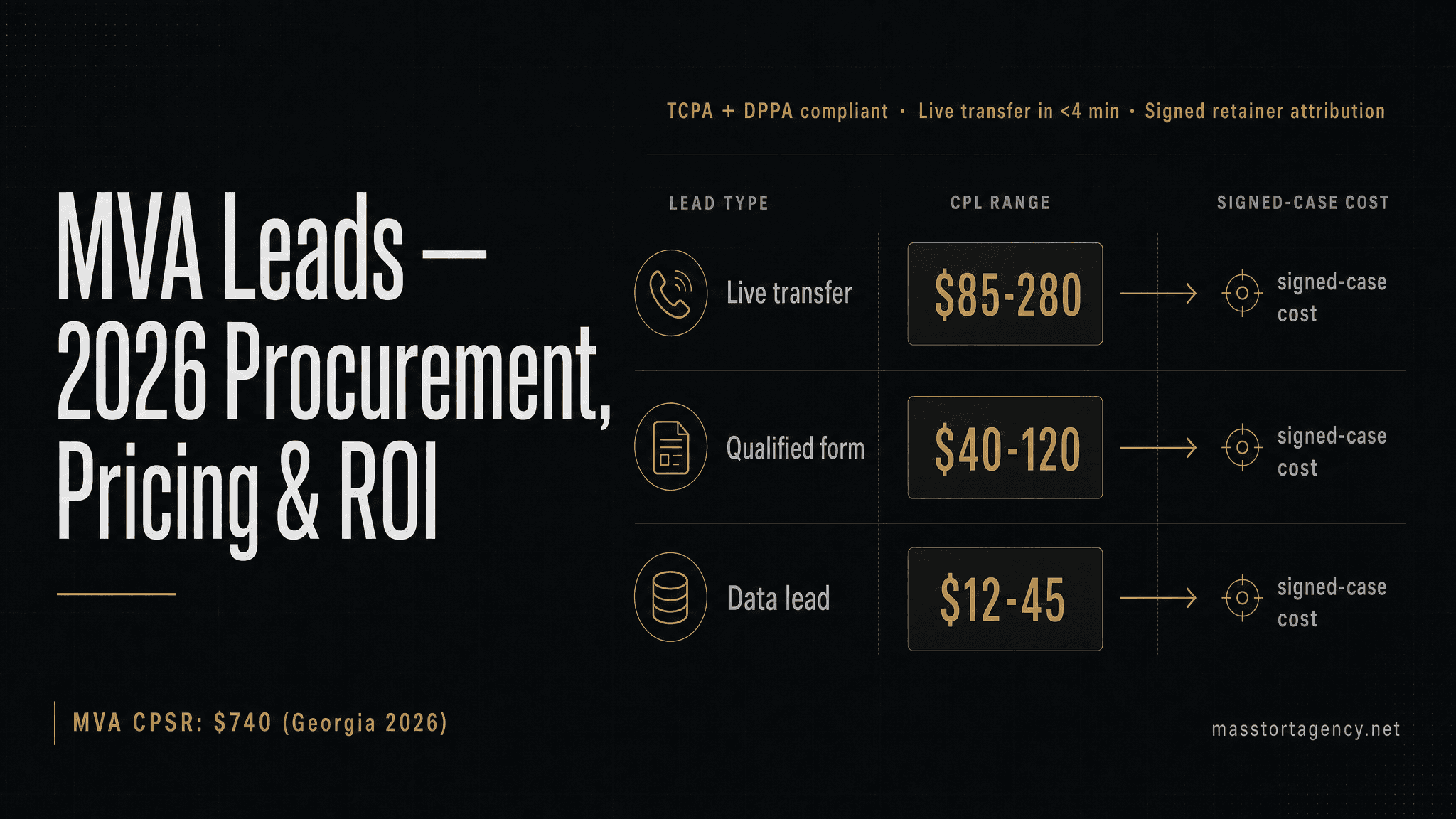
There are three stable tiers in the MVA lead market. Prices below are national mid-market benchmarks from our 2024–2026 buying data. Individual states, commercial MVA, and trucking cases carry meaningful premiums.
| Tier | Typical CPL | Contact rate | Retainer rate | Blended CPR |
|---|---|---|---|---|
| Shared data lead | $35–$90 | 15–25% | 2–6% | $1,500–$4,500 |
| Qualified form lead (exclusive) | $120–$280 | 45–65% | 12–22% | $900–$2,300 |
| Live transfer (exclusive) | $350–$750 | 92–98% | 30–48% | $850–$2,200 |
| Trucking / commercial MVA | $750–$1,800 | 85–95% | 22–38% | $2,200–$6,500 |
The lesson sitting inside this table: exclusive tiers routinely produce a lower blended cost per signed retainer than shared inventory, even at 4–10x the sticker price per lead. Firms that chase CPL are almost always overpaying per case.
What actually makes an MVA lead qualified
A qualified MVA lead is defined by five pre-intake confirmations, not by the marketing that produced it:
- Police report confirmed or imminent. A report establishes fault documentation and is the single largest predictor of retainer conversion.
- Medical treatment initiated or scheduled. No-treatment cases collapse in valuation; treatment within 30 days of the accident is the practical threshold.
- Liability posture favorable. The claimant was not primarily at fault under the applicable comparative or contributory negligence rule.
- Statute margin. The accident date sits comfortably inside the state's statute of limitations, with enough runway to litigate.
- No prior representation. Confirmed before the lead is delivered, ideally on a recorded call.
Anything that skips these checks is a data record, not a qualified lead. Vendors that won't commit to these confirmations in a written SLA are selling you someone else's problem.
Lead decay: why speed is the underrated variable
Independent studies from MIT, InsideSales, and Velocify have all landed on the same finding: contact rate for inbound consumer leads drops steeply within the first hour after submission, and by 24 hours the probability of reaching the claimant has fallen by roughly 80%.
MVA behaves the same way. A claimant who completes a form at 7:45 p.m. and is contacted at 8:15 a.m. the next morning is fundamentally a different asset than a claimant contacted at 7:47 p.m. that night. The claimant who fills out your form has almost certainly filled out two or three others — speed is what determines who signs the retainer.
Live transfer exists to eliminate this entirely. A properly run transfer closes lead-to-contact to zero seconds because the claimant is already on the line. If your vendor delivers leads in batches every 6–12 hours, you are buying decayed inventory at full price.
Live-transfer MVA leads, screened in under four minutes
Exclusive motor vehicle accident claimants — police report, treatment, liability, and representation pre-verified — transferred directly to your intake team.
See our MVA Lead ProgramTCPA and DPPA: the compliance posture non-negotiables
TCPA — 2024 one-to-one consent
In 2024, the FCC finalized its TCPA one-to-one consent rule, reshaping consumer consent for every paid-acquisition channel that results in outbound calls or texts. In practical terms: a consent checkbox that says "I agree to be contacted by partners" is no longer sufficient. Consent must name the specific calling party, and the consenting party must be able to identify who will contact them.
For MVA lead buyers, this means:
- You need access to the exact consent language shown at submission.
- You need IP, timestamp, user-agent, and the signed consent record.
- You should be named on the consent form, not reached through a third-party aggregator.
- You should retain the consent record for at least 4 years (7 recommended), since TCPA statute of limitations plus litigation tails extend that far.
DPPA — driver data is not marketing data
The federal Driver's Privacy Protection Act (18 U.S.C. § 2721) restricts the use of DMV-derived personal information to a specific list of permissible uses. Marketing and lead generation are not on that list. If a vendor's MVA data product is "sourced from state DMV records," ask them to show you the permissible-use basis in writing — most of them cannot.
The safer posture: MVA leads should come from consumer-consented inbound channels (search, social, TV, landing pages), not from brokered driver records. That is the posture we operate under, and it is the posture we recommend to every firm we work with.
ROI framework: from lead to signed retainer to settled case
Cost per signed retainer is the number that matters. It is computed as:
CPR = CPL ÷ (Contact Rate × Qualified Rate × Retainer Rate)
A $150 CPL at 55% contact × 60% qualified × 30% retainer rate produces a $1,515 CPR. A $450 live-transfer CPL at 95% × 90% × 45% produces a $1,169 CPR — despite costing three times as much per lead. The arithmetic favors the higher tier almost every time because the downstream multiplication compounds.
The next layer — which most firms skip — is cost per settled case. Not every signed retainer becomes a settlement. Case drop-off between retainer and settlement runs 15–30% depending on state, injury, and fault posture. If your firm settles 80% of signed MVA cases and the average fee per settlement is $11,500, then a $1,169 CPR produces roughly $8,031 of net fee per signed case — a 7:1 return. A $3,000 CPR on shared inventory produces $6,200 per case — still positive, but the exclusive tier wins by 30%+ on a blended basis.

State dynamics that change the math
MVA lead economics vary by state more than any other factor. Three dynamics dominate:
- Negligence rules. Pure comparative (CA, FL, NY) states price claimant viability wider than modified comparative 50% bar states (GA, TN, TX at 51%) or contributory negligence states (AL, MD, NC, VA, DC) which are the hardest lead markets in the country.
- No-fault regimes. NY, FL, MI, NJ, PA, MA, and others layer a no-fault PIP system on top of liability. In New York, the § 5102(d) serious-injury threshold screens out a huge portion of otherwise-signable MVA claims. Vendor criteria should reflect that.
- Statute of limitations. Two-year SOL states (GA, TX, CO, IL among others) require faster intake than four-year states (FL). Older leads in GA are worth less than older leads in FL simply because of SOL proximity.
Rideshare, trucking, and commercial MVA: different products
Rideshare
Uber and Lyft claims require verification of the rideshare relationship (driver, passenger, or third-party vehicle), the coverage tier at the time of the incident (Period 1, 2, or 3), and whether the rideshare app was active. Period 3 claims — passenger in an active trip — carry a $1M commercial policy, which drives case values and, correspondingly, acceptable CPR levels well above standard MVA.
Trucking / commercial MVA
Commercial motor vehicle cases are a different product. FMCSA data pinpoints roughly 5,800 large-truck fatalities per year in the U.S., and the ATA tracks over 500,000 reportable truck crashes. Case values are substantially higher and justify CPL in the $750–$1,800 range with CPRs in the $2,200–$6,500 range. Qualifying criteria expand to include FMCSA authority lookups, driver HOS violations, and ELD data preservation — which your lead vendor should understand.
Building vs. buying: the blended-model default
The firms with the strongest MVA economics in 2026 run a blended model: in-house acquisition for core markets (paid search, Meta, local TV, SEO, referral) and purchased leads for overflow, new-market entry, and off-peak volume smoothing. In-house matures slowly — expect 12 to 18 months to reach a lower cost per case than the exclusive-lead tier — but once it does, it compounds.
For firms without a marketing team, outsourced live-transfer is the right starting point. It gives you the same unit economics without the 18-month runway, and it frees your attorneys to focus on cases instead of creative reviews.
We run both sides for you
In-house-quality acquisition without the 18-month runway. Compliance-reviewed creative, live-transferred qualified claimants, and post-sign attribution reconciled to your case management system every week.
Talk to Our TeamFAQ
Shared MVA data leads run $35–$90. Qualified exclusive form leads run $120–$280. Live-transferred, pre-qualified MVA leads run $350–$750 depending on state, injury severity, and whether commercial trucking is included. Cost per lead is a secondary metric — cost per signed retainer is what matters, and higher-quality tiers almost always win on a blended basis.
A qualified MVA lead confirms a minimum of five data points: (1) a reported or imminent police report, (2) the claimant is receiving or has scheduled medical treatment, (3) the claimant was not primarily at fault, (4) the accident date is within your state's statute window with margin to spare, and (5) the claimant has not already retained another firm. Anything short of that is a data record, not a qualified lead.
Contact rate drops roughly 50% in the first hour after the inquiry and another 30% by hour six. By 24 hours, a typical MVA lead has lost ~80% of its contact probability. Live transfers work because they collapse lead-to-contact to zero. If your vendor delivers leads in batches every 6–12 hours, you are buying decayed inventory at full price.
They can be, but most aren't. TCPA compliance requires express written consent captured at submission, with proof of IP, timestamp, user agent, and exact consent language — and the FCC's 2024 one-to-one consent rule requires the consent name the specific calling party. DPPA compliance matters when any DMV-derived data is in the record. Demand artifacts, not assurances.
For most firms, the answer is exclusive. Shared leads (sold to 3–5 firms) have contact rates below 25% and retainer rates below 6%. Exclusive leads cost 3–5x more but typically convert 3–8x better, producing a lower blended cost per signed case. The exception is firms with very large, mature intake operations that can out-hustle competitors on shared inventory — and even then, the math rarely wins.
Benchmarks vary by state and case type, but a well-run exclusive MVA program lands cost per signed retainer in the $950–$2,800 range. Rear-end soft-tissue sits at the low end; commercial trucking and catastrophic injury cases sit at the high end and comfortably support it. If your current CPR exceeds $3,500 on non-catastrophic MVA, your sourcing or intake has a fixable problem.
Rideshare (Uber, Lyft) MVA leads require verification of the rideshare relationship (driver vs. passenger vs. third-party vehicle), the coverage tier at the time of the incident (Period 1, 2, or 3), and whether the rideshare app was active. Case values are higher because of the $1M commercial coverage during Period 3, but qualification is more complex and the vendor pool is thinner.
Yes, and the better firms do. In-house mass tort-style MVA acquisition (paid search, Meta, local TV, SEO, referral) produces lower cost per retainer at scale, but it requires a marketing team, a compliance function, and a 12-to-18-month runway to mature. Most firms run a blended model — in-house for core markets, purchased leads for overflow and new markets.
Sources
- U.S. DOT NHTSA — Traffic Safety Facts Annual Report (2024).
- Insurance Institute for Highway Safety (IIHS) — Fatality Facts (2024).
- Federal Motor Carrier Safety Administration — Large Truck and Bus Crash Facts.
- FCC — TCPA 2024 final rule (one-to-one consent), 47 C.F.R. § 64.1200.
- 18 U.S.C. § 2721 — Driver's Privacy Protection Act.
- American Bar Association — Model Rule 7.3 (Solicitation of Clients).
- MIT Lead Response Study; InsideSales / Velocify lead-decay research.
- Mass Tort Agency — internal buying and operating data, 2024–2026 (175+ PI firms).
About the author
Tarun is the founder of Mass Tort Agency, a legal marketing firm headquartered in San Francisco, California. He has spent 12+ years building plaintiff acquisition programs for personal injury and mass tort law firms. Since 2019, his team has reviewed more than 400,000 claimant calls and supported 175+ PI firms across motor vehicle accident, trucking, and mass tort litigation. He has co-authored CLE curricula on TCPA and DPPA compliance in legal marketing. He is contactable via the contact page.
This guide is reviewed for factual accuracy on a rolling 90-day cadence. Published April 23, 2026. Last reviewed April 23, 2026. Material changes are timestamped in-page. Nothing on this page is legal advice.