
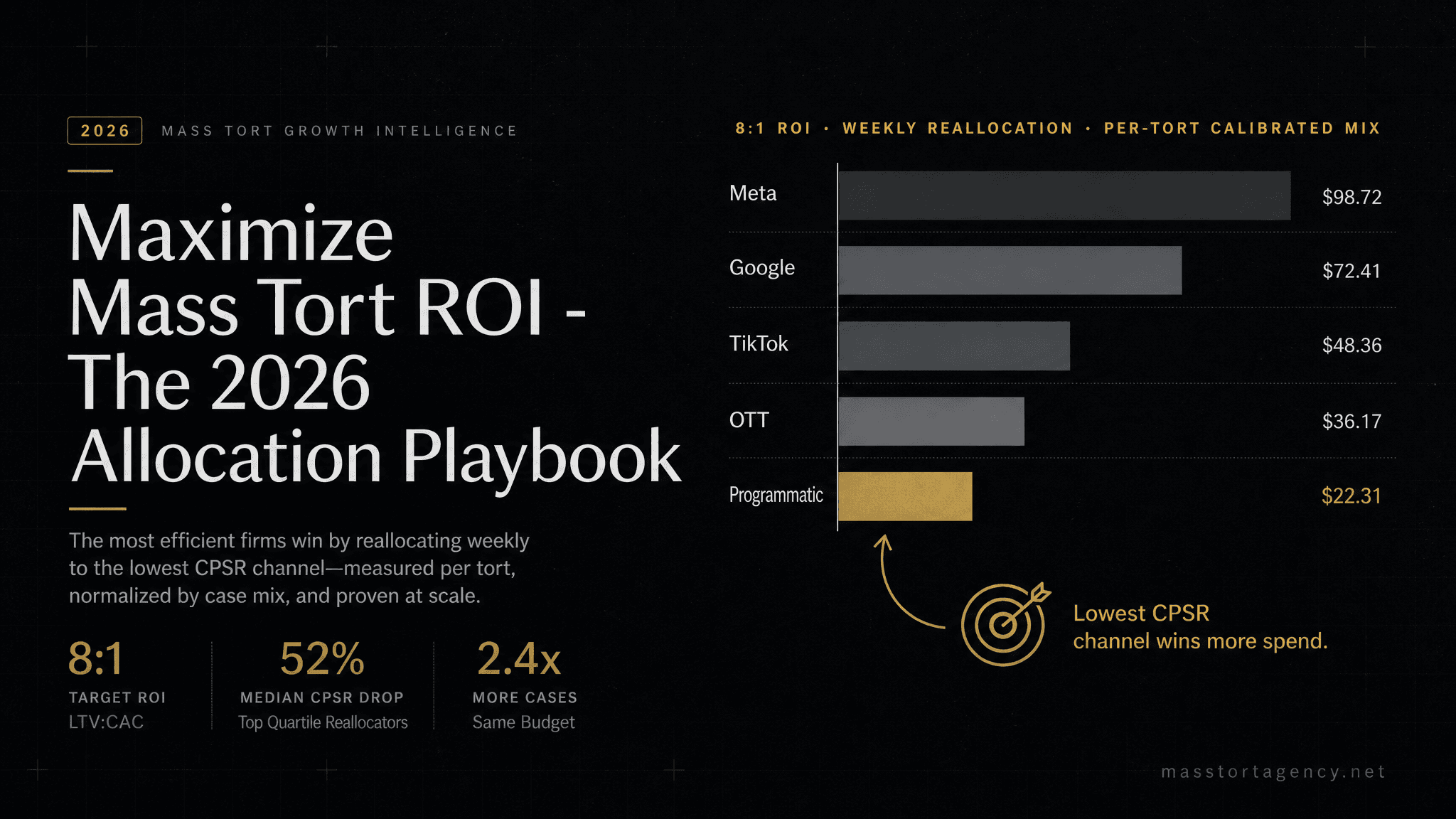
Why mass tort ROI demands a different framework
Personal injury attorneys accustomed to single-event cases — car accidents, slip-and-falls, medical malpractice — often apply the same financial thinking to mass tort lead generation. That is a costly mistake. Mass tort economics operate on fundamentally different timelines, risk profiles, and scale dynamics than individual PI cases.
A car accident case moves from intake to resolution in 12-18 months. A mass tort case may take 3-7 years from plaintiff acquisition to settlement distribution. This extended timeline changes everything: how you account for acquisition costs, when you recognize revenue, how much working capital you need, and how you evaluate whether a campaign is "working."
The firms generating the highest returns in mass torts treat lead acquisition as a portfolio investment, not a marketing expense. They model expected returns across multiple torts, diversify against litigation risk, and make data-driven decisions about when to scale spend and when to cut losses. This article provides the frameworks to do exactly that.
The firms that win in mass torts don't think about "marketing budgets." They think about capital deployment with measurable, risk-adjusted returns — and they manage their tort portfolio the way a fund manager manages assets.

Understanding per-lead economics across torts
Not all mass tort leads are created equal. The cost to acquire, qualify, and convert a lead varies enormously depending on the tort, the acquisition channel, and the screening criteria applied. Firms that fail to model per-lead economics at the tort level will inevitably overspend on low-value cases and underspend on high-value opportunities.
Breaking down the cost structure
Every mass tort lead has four cost components: media spend (the cost to generate the initial contact), screening cost (medical records review, qualification calls, criteria verification), intake cost (attorney review, retainer execution, case setup), and carry cost (the cost of maintaining the case through resolution). Most firms only track media spend, which is like evaluating a stock purchase by the brokerage fee.
Cost benchmarks by tort category
Pharmaceutical torts like Ozempic gastroparesis and Risperdal gynecomastia typically produce leads in the $200-$600 range for raw contacts, with fully qualified and screened leads running $800-$2,000. Medical device torts like hernia mesh and Bard PowerPort trend higher at $400-$900 for raw contacts due to more specific qualifying criteria.
Environmental torts such as Camp Lejeune water contamination and PFAS forever chemicals vary widely. Camp Lejeune leads were among the cheapest mass tort leads in history during the initial filing wave ($75-$200), but have since risen substantially as the qualified population narrows. PFAS leads remain relatively expensive due to exposure verification requirements.
| Tort Category | Raw Lead Cost | Screened Lead Cost | Avg Settlement |
|---|---|---|---|
| Pharmaceutical | $200 – $600 | $800 – $2,000 | $150K – $350K |
| Medical Device | $400 – $900 | $1,200 – $3,000 | $200K – $500K |
| Environmental | $150 – $500 | $600 – $1,500 | $75K – $250K |
| Consumer Product | $250 – $700 | $900 – $2,500 | $100K – $300K |
| Toxic Exposure | $300 – $800 | $1,000 – $2,800 | $125K – $400K |
The real metric: cost per signed retainer
Raw lead cost is vanity. Screened lead cost is better. But the only metric that truly matters is cost per signed retainer — the total acquisition spend divided by the number of clients who actually sign fee agreements. This figure accounts for all the leakage in your funnel: unqualified leads, no-shows, prospects who sign with other firms, and intake failures. Top-performing firms track this number daily, by tort and by channel.
Budget allocation: the portfolio approach
Sophisticated mass tort firms allocate budget across torts the way institutional investors allocate capital across asset classes. Each tort represents a position with its own risk-return profile, liquidity characteristics, and correlation to other positions.
Core, growth, and speculative allocations
Divide your mass tort budget into three tiers. Core allocations (50-60% of budget) go to proven, mature torts with established settlement values and predictable lead economics — torts like Roundup or hernia mesh where the litigation is well advanced. Growth allocations (25-35%) target mid-stage torts with strong momentum — MDLs that have survived key motions and are approaching bellwether trials. Speculative allocations (10-15%) fund early-stage torts where the science is emerging and litigation outcomes remain uncertain.
Rebalancing triggers
Rebalance your portfolio when any of these triggers fire: a bellwether trial produces a verdict significantly above or below expectations; a global settlement is announced; a key scientific study is published that strengthens or weakens causation arguments; your cost per signed retainer on a specific tort moves more than 20% from baseline; or a new MDL is formed in a category you are already active in.
Review allocations quarterly at minimum, monthly during active litigation phases. The firms that outperform are not the ones with the biggest budgets — they are the ones that reallocate fastest when conditions change.
Want to optimize your mass tort lead spend?
Mass Tort Agency provides detailed per-lead economics, conversion data, and ROI projections across every active tort category. See how your numbers compare.
View All Tort CategoriesHow screening transforms your conversion funnel
The difference between a profitable mass tort practice and a money-losing one often comes down to a single variable: screening quality. Pre-screening leads before they reach your intake attorneys is the highest-leverage investment you can make in your mass tort operation.
The 62% conversion lift
Across our client base, firms that implement rigorous multi-step screening see an average 62% improvement in lead-to-signed-retainer conversion rates. Unscreened leads convert at roughly 10-15%. Leads that pass through medical criteria verification, exposure confirmation, statute of limitations checks, and prior representation screening convert at 25-40%.
What effective screening looks like
Tier-one screening happens at initial contact: basic demographic qualification, exposure or use confirmation, and injury verification. This eliminates 40-50% of raw leads. Tier-two screening involves medical records review or detailed questionnaire completion that confirms the lead meets specific MDL criteria. This eliminates another 20-30%. The remaining leads — 20-35% of the original volume — are genuinely qualified and ready for attorney intake.
The math is counterintuitive for many firms. Paying $1,500 for a screened lead feels expensive compared to $300 for a raw lead. But when the screened lead converts at 35% and the raw lead at 10%, the cost per signed case is $4,285 versus $3,000 — and the screened lead consumed zero attorney time during qualification. When you factor in the opportunity cost of attorney time spent on unqualified leads, screening nearly always wins.

Multi-channel attribution: knowing what actually works
Mass tort lead generation typically involves five or more channels running simultaneously: paid search, social media advertising, television, digital display, content marketing, and referral networks. Without proper attribution, you are flying blind — spending money on channels that feel productive but may not be driving signed cases.
Why last-click attribution fails for mass torts
Most firms default to last-click attribution: crediting the channel that generated the final conversion. In mass torts, this systematically overstates the value of branded search and direct website visits while understating the value of awareness channels like television, social media, and display advertising. A prospect may see a TV spot, research on social media, read a blog article, and then convert via a Google search. Last-click gives 100% credit to Google. That is wrong.
Implementing weighted multi-touch attribution
The most practical model for PI firms assigns weights across the customer journey: 40% to first touch (the channel that introduced the prospect to your firm or the tort), 20% to middle touches (engagement channels like content, email, social), and 40% to the converting touch (the final action that triggered intake). This balances the importance of awareness with the importance of conversion.
Implementing this requires tracking across channels, which means UTM parameters on every link, call tracking numbers unique to each channel, and a CRM that captures the full touchpoint history. The setup takes 2-4 weeks and costs $500-$2,000/month in tooling. The insight it provides is worth 10x that in optimized spend allocation.
Revenue forecasting for mass tort portfolios
Revenue forecasting in mass torts requires a probability-weighted model that accounts for litigation risk, settlement timing, and case attrition. Firms that can accurately forecast revenue make better hiring decisions, better capital allocation decisions, and better growth decisions.
The probability-weighted pipeline model
For each tort in your portfolio, estimate three variables: expected settlement value per case (use published bellwether results, MDL committee reports, and peer intelligence), probability of favorable outcome (100% for settled torts, 60-80% for torts with strong bellwether results, 30-50% for pre-bellwether torts), and expected time to resolution. Multiply cases x settlement x probability x fee percentage to get expected revenue. Discount for time value if the timeline exceeds 24 months.
Building a revenue forecast spreadsheet
Create a tort-by-tort forecast with these columns: tort name, signed cases, estimated settlement per case, contingency fee, expected win rate, gross expected fees, estimated case costs, net expected fees, expected resolution date, and present value (discounted at 10-15% annually). Sum across torts for your total portfolio value. Update monthly as you sign new cases and as litigation developments change your probability estimates.
| Tort | Cases | Avg Settlement | Win Rate | Expected Fees |
|---|---|---|---|---|
| Roundup | 150 | $275,000 | 75% | $10.2M |
| Hernia Mesh | 85 | $350,000 | 70% | $6.9M |
| Hair Relaxer | 200 | $200,000 | 60% | $7.9M |
| Camp Lejeune | 300 | $150,000 | 65% | $9.6M |
| Ozempic | 120 | $225,000 | 50% | $4.5M |
When to scale versus when to cut
The most expensive mistake in mass tort lead generation is scaling a losing campaign. The second most expensive mistake is cutting a winning campaign too early. Distinguishing between the two requires discipline, data, and patience.
Signals to scale
- Cost per signed retainer trending down: Your intake team is getting more efficient, or lead quality is improving. Either way, more spend will amplify the trend.
- Positive litigation developments: Favorable bellwether verdicts, denial of summary judgment motions, or settlement negotiations beginning. These signal higher probability and often higher settlement values.
- Intake capacity available: Your team can absorb 30-50% more volume without quality degradation. If intake is already strained, scaling spend creates bottlenecks that waste leads.
- Channel saturation is not yet reached: You are not yet seeing diminishing returns on incremental spend in your primary channels.
Signals to cut
- Cost per signed retainer exceeding 2x your target: Sustained above-target costs with no downward trend indicate a structural problem, not a temporary fluctuation.
- Negative litigation developments: Adverse rulings on causation, Daubert challenges succeeding, or bellwether losses. These reduce both the probability and expected value of cases.
- Lead quality declining: Rising rates of disqualification at screening suggest the addressable market is shrinking or your channels are reaching lower-quality segments.
- Settlement values compressing: If published settlements are coming in below expectations, the math on acquisition costs must be recalculated.
The 4.2x revenue multiplier: what top firms do differently
Across our client base, the top quartile of firms generates 4.2 times the revenue per dollar of lead spend compared to the median. This is not because they have better cases or better lawyers — it is because they execute six specific practices that compound their returns.
Immediate speed-to-lead
Top firms contact new leads within 5 minutes. Median firms take 2-4 hours. Speed-to-lead is the single strongest predictor of conversion rate in mass torts.
Multi-tort cross-qualification
When a lead doesn't qualify for the target tort, top firms screen for other active torts. A failed Ozempic lead may qualify for Depo-Provera. This recovers 15-25% of otherwise lost leads.
Persistent follow-up cadence
Top firms attempt contact 8-12 times across phone, text, and email over 14 days. Median firms give up after 3-4 attempts. Persistence alone improves conversion by 30%.
Retainer before records
Sign the client first, then gather records. Firms that require medical records before signing lose 40% of qualified leads to competitors with faster onboarding.
Case cost financing
Top firms have lines of credit or litigation funding that allow them to carry larger inventories without cash flow constraints. This enables aggressive acquisition without financial stress.
Referral fee optimization
When a case doesn't fit the firm's primary expertise, top firms refer to specialists for 25-33% referral fees. This monetizes 100% of signed cases, not just the ones the firm litigates directly.
Ready to see what 8:1 ROI looks like?
We work with PI firms to design mass tort lead campaigns that deliver measurable, trackable returns. Exclusive leads, transparent pricing, real-time reporting.
Start Your CampaignPortfolio diversification: protecting against litigation risk
No mass tort is guaranteed. Even strong cases can be derailed by adverse rulings, bankruptcy filings, or legislative changes. Portfolio diversification is the only reliable protection against single-tort risk.
Optimal portfolio composition
Data from our client base suggests that the optimal mass tort portfolio contains 4-6 active torts across at least three categories (pharmaceutical, medical device, environmental/consumer product). Firms with fewer than three torts have 2.5x the revenue volatility of diversified firms. Firms with more than eight torts often suffer from operational dilution — intake quality drops as the team splits attention across too many qualifying criteria.
Correlation and hedging
Some torts are positively correlated — they share defendants, legal theories, or judges. A pharmaceutical firm with Ozempic and Depo-Provera cases has two independent bets. A firm with Roundup and a hypothetical second glyphosate tort has one correlated bet. Diversify across categories to minimize correlation. If one pharmaceutical tort fails, your environmental and device torts are unaffected.

Channel economics: where to spend your next dollar
Each acquisition channel has a different cost structure, lead quality profile, and scalability ceiling. Understanding these differences is essential to allocating your next marginal dollar of spend.
Paid search
Google Ads remain the highest-intent channel for mass torts. Prospects actively searching for "Ozempic lawsuit" or "hernia mesh lawyer" are pre-qualified by their own behavior. Cost per click ranges from $15-$85 depending on the tort, with conversion rates of 5-15% from click to lead. The channel scales well up to a ceiling set by search volume — once you are capturing 30-40% of available queries, additional spend produces diminishing returns.
Social media advertising
Facebook and Instagram generate high volumes of lower-intent leads. Cost per lead is typically 40-60% lower than paid search, but conversion rates are also 40-60% lower. Social works best as a top-of-funnel awareness channel feeding a retargeting and nurturing sequence. Direct-response social campaigns work for torts with broad exposure criteria where awareness is the primary barrier to lead generation.
Television and CTV/OTT
Traditional television remains powerful for mass torts targeting older demographics — Camp Lejeune, hernia mesh, and Zantac respond well to TV. Connected TV (CTV) and over-the-top (OTT) platforms offer television-quality reach with digital-quality targeting. Cost per lead is typically the highest of any channel, but lead quality — measured by signed retainer rate — is often the best. Firms considering TV should budget a minimum of $25,000/month for meaningful testing.
Measuring what matters: the ROI dashboard
Every mass tort firm should maintain a real-time dashboard tracking seven key metrics. These are the numbers that drive every budget decision, staffing decision, and portfolio decision.
- Cost per raw lead — by tort, by channel, by week.
- Screening pass rate — percentage of raw leads that pass qualification criteria.
- Cost per qualified lead — raw lead cost divided by pass rate.
- Contact rate — percentage of qualified leads you successfully reach.
- Cost per signed retainer — the real acquisition cost, including all upstream costs.
- Expected case value — probability-weighted settlement value minus costs.
- Portfolio ROI — total expected fees divided by total acquisition spend, across all torts.
If you are not tracking all seven, you are missing part of the picture. If you are tracking them but not reviewing weekly, the data is wasted. Build the dashboard, staff someone to maintain it, and review it every Monday morning.
Putting it all together: the 2026 playbook
The mass tort market in 2026 is more competitive, more data-driven, and more profitable than ever — for firms that approach it with rigor. Here is the summary framework for maximizing your ROI this year.
- Model per-lead economics for every tort you are considering. Know your cost per signed retainer before you scale.
- Allocate budget like a portfolio — core, growth, and speculative positions across diversified tort categories.
- Invest in screening before you invest in volume. Screening is the highest-ROI dollar you can spend.
- Implement multi-touch attribution so you know which channels actually drive signed cases, not just leads.
- Forecast revenue using probability-weighted models. Know your expected return before cases resolve.
- Scale on data, cut on data. Never scale on hope. Never cut on fear.
- Build the dashboard and review it weekly. The firms that out-earn their peers are the firms that out-measure them.
Mass tort lead generation is not marketing. It is a capital deployment strategy with measurable returns. Treat it that way, and the returns will follow. Learn more about specific lead generation strategies for individual torts by exploring our guide to plaintiff acquisition trends or our scaling playbook for multi-litigation firms.
