The headline number
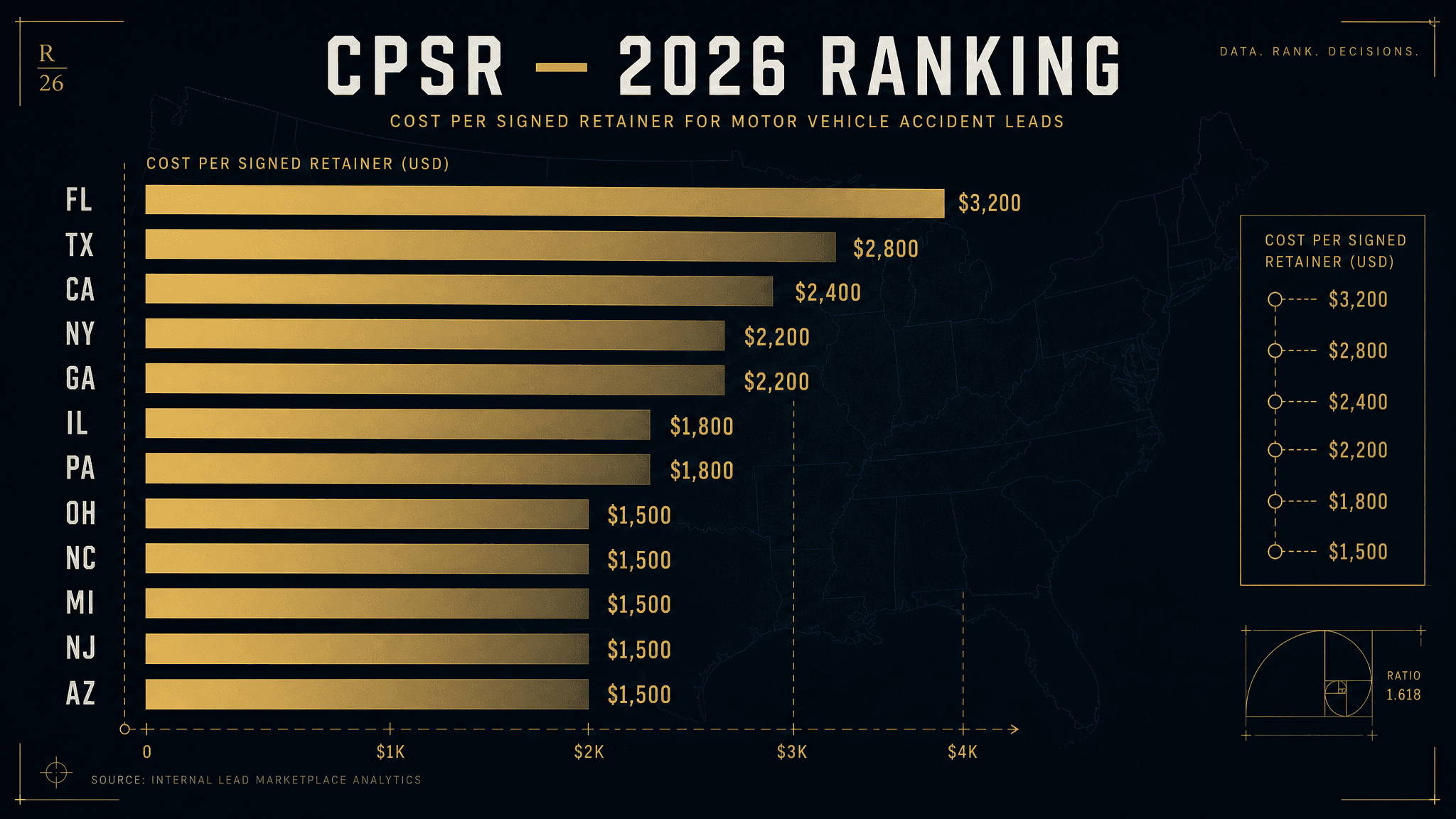
In 2026, the procurement-grade midpoint cost per signed retainer for motor vehicle accident leads ranges from $1,950 at the low end (Georgia) to $3,350 at the high end (California) — a 3× spread across just the 25 most-active state markets we track.
That spread is not random. It tracks an underlying variable most procurement decisions ignore: state-specific qualification difficulty. Florida CPSR is not Georgia CPSR. They are pricing different products — different negligence rules, different statute-of-limitations pressure, different coverage frameworks. Vendors who quote a single "national CPL" are quietly transferring state-arbitrage risk to the buying firm.
The ranking
States sorted by signed-retainer cost (midpoint of the procurement-grade band Mass Tort Agency observes in 2024–2026 buy cycles). Each entry includes the State Qualification Index™ aggregate score for context.
The five drivers of CPSR variance
CPSR is the output of five inputs that vary by state. Each input maps to one axis of the State Qualification Index™.
1. Negligence-rule severity — the 5x case-value swing
The single biggest CPSR driver. Pure contributory negligence states (North Carolina, Virginia, Maryland, Alabama)bar all recovery at 1% claimant fault — meaning roughly 20–30% of cases that would convert in a comparative-negligence state wash out at the fault-apportionment stage. Vendors selling NC leads at GA prices are quietly underwriting that wash-out cost on the firm's P&L.
At the other end: pure-comparative states (California, New York, Arizona, Kentucky, Louisiana, Washington, Missouri) preserve recovery at any fault level. A claimant 70% at fault still recovers 30% of damages. That structural tailwind translates directly into higher case values and tolerates higher CPLs at the procurement stage.
2. SOL pressure — velocity vs. patience
Tennessee, Louisiana, and Kentucky run the country's shortest personal injury statutes of limitations at 1 year. Lead vintage matters more in these states than anywhere else — a 90-day-old lead in TN has less than 75% of its filing window remaining. That compresses the intake throughput requirement and pushes live-transfer pricing 12–18% above similar at-fault states with 2-year SOLs.
Missouri sits at the opposite end with a 5-year SOL. Vintage data tiers monetize cleanly there. Vendors who price MO leads on a 2-year-SOL assumption are leaving margin on the table.
3. Liability-framework complexity — the qualification gates count
At-fault states have one qualification gate (fault). No-fault states have two (fault + threshold). Choice no-fault states have three (fault + threshold + tort election). Modified no-fault Michigan has four (fault + threshold + tort election + PIP tier election under 2019 PA 21).
Each gate is a per-lead intake cost. The more gates, the higher the per-qualified-lead cost — which shows up directly in CPSR. Michigan and New York carry structurally higher CPSR than Texas not because Texas is "cheaper" but because Texas has fewer qualification gates to clear.
4. Bar-advertising restrictiveness — the operational tax
Louisiana, Texas, and New York operate the most restrictive lawyer-advertising regimes in the country. Louisiana Rule 7.7 requires pre-approval by the State Bar's Lawyer Advertising Committee for non-exempt ads. Texas Disciplinary Rule 7.02 requires Advertising Review Committee sign-off. Most national lead vendors don't comply — and the resulting cease-and-desist exposure shows up in CPSR via higher vendor turnover and consent-record-maintenance costs.
5. Coverage-availability difficulty — what's actually recoverable
Louisiana sits at a top-5 uninsured-motorist rate (12–14% per IRC data). Texas runs at 14%. Arizona at ~12%. In these states, a meaningful share of cases involve at-fault drivers with no recoverable coverage — and CPSR has to absorb the cases that look strong on liability but die on collectability.
New York's mandatory $50,000 PIP guarantees first-dollar coverage. Michigan's post-PA 21 four-tier PIP election goes up to unlimited. These states have structurally lower coverage-availability risk and the CPSR math reflects it.
What this means for procurement
If a vendor quotes you a single national CPL — they're hiding the variance. Demand state-level pricing. If a vendor can't explain why North Carolina CPSR is 25% higher than Georgia CPSR — they don't understand contributory negligence. Don't buy from them.
The State Qualification Index™ score is a leading indicator of state-level CPSR. The correlation isn't perfect — coverage availability and bar-advertising restrictiveness pull in different directions than fault-rule severity in some states — but the rank-order tracks closely. If a vendor's state-by-state CPSR doesn't correlate with the Index, ask why.
The procurement playbook
For PI firms evaluating MVA lead vendors in 2026:
- Always request state-by-state CPL. Anyone quoting a national average is hiding $1,500+ of state-arbitrage variance per signed retainer.
- Test the contributory-negligence question. Ask the vendor how they qualify leads in North Carolina vs Georgia. If they can't articulate the difference, walk.
- Match vintage to SOL. Buy older vintage in Missouri (5-year SOL). Buy fresh-only in Tennessee (1-year SOL).
- Demand coverage-status capture. In LA, TX, and AZ, UM/UIM status is non-negotiable. Vendors who skip this are gambling on the at-fault driver having coverage.
- Verify bar-advertising compliance. In LA, TX, and NY, the vendor's ads should be on file with the state bar. Ask for the documentation.
Bottom line
CPSR is not a single number. It's a function of state law. Firms that buy national-average leads pay $1,500+ extra per signed retainer they don't need to. Firms that buy state-tier leads with documented qualification frameworks pay what the underlying tort framework actually justifies — and build a defensible procurement story for their docket managers, COOs, and outside counsel.