
Interactive tool · State-specific
MVA Case Value Estimator
What's the recoverable case value for a motor vehicle accident claim? The answer depends on the state's tort framework — and most calculators ignore it. This one doesn't.
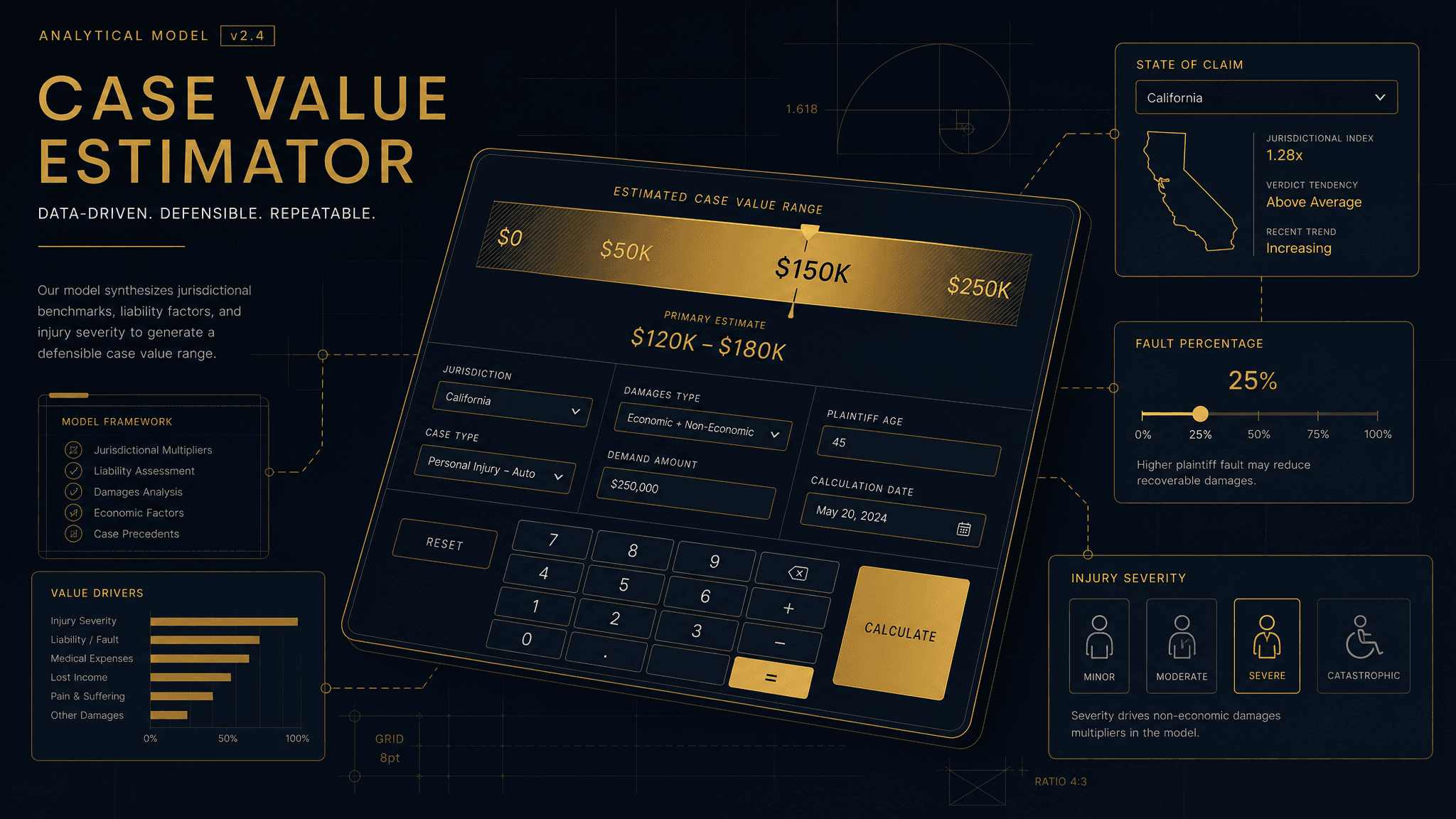
Inputs
Tell us about the case
Awaiting inputs
Complete the five fields on the left to see a state-specific case-value range. The estimator factors in the underlying tort framework, negligence rule, and coverage profile.
Methodology
How the estimate is computed
The estimator takes five inputs (state, injury severity, fault percentage, treatment status, coverage profile) and applies the state's documented tort framework to compute a recoverable case-value range. The output is intentionally conservative.
Base economic damages (medical + lost wages) scale with injury severity. Non-economic damages (pain and suffering) are computed as a multiplier of economic damages, but are gated by the state's framework: no-fault states with serious-injury thresholds bar non-economic damages for minor and moderate cases that don't clear the threshold; choice no-fault states (PA, NJ, KY) gate non-economic damages on the claimant's tort election; California's PROP 213 bars uninsured claimants from recovering non-economic damages even when the at-fault driver is 100% liable.
Fault apportionment then applies: pure contributory states (NC, VA, MD, AL) bar all recovery at 1% claimant fault; modified-50 states (GA, CO, TN) bar at 50%; modified-51 states bar at >50%; pure-comparative states (CA, NY, AZ, KY, LA, WA, MO) reduce recovery proportionally but never bar.
Coverage profile caps the upper bound: policy-minimum cases recover at most what the at-fault driver's policy will pay; uninsured cases recover only via UM/UIM stacking on the claimant's own policy.
Important caveats
- • This is an order-of-magnitude estimate. Actual case values depend on jury venue, insurance tower depth, specific medical billing, plaintiff profile, and case-management quality — facts the estimator cannot see.
- • The estimator does not constitute legal advice. Consult a licensed personal injury attorney for case-specific evaluation.
- • Output is conservative by design — it reflects what's typically recoverable, not what's theoretically maximally recoverable in a perfect fact pattern.
Go deeper
State-by-state tort frameworks
The estimator runs on the data documented in our state qualification framework pages. Each state has its own no-fault rules, comparative-negligence treatment, SOL, and coverage requirements — see the full breakdown: