
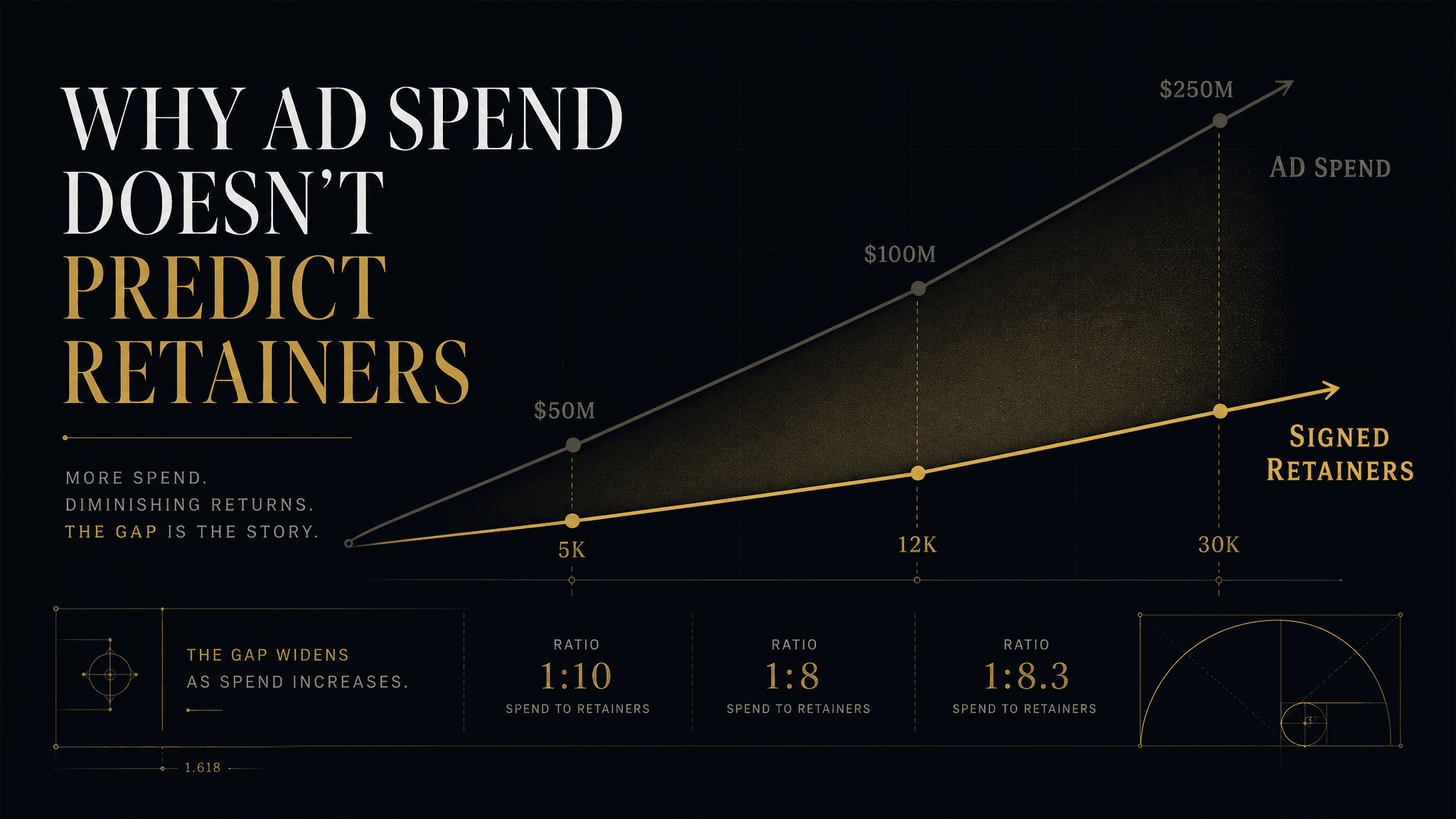
The pitch deck
Open any mass tort marketing agency's homepage in 2026 and you'll see a variation of the same three numbers, formatted as a hero band:
- $250 million in ad spend deployed
- 600+ law firms served
- 2 million leads generated
The numbers vary by agency. The format doesn't. These three figures are the category's default proof points — the procurement equivalent of "trust me, I'm big."
And to be fair, scale matters. A vendor that has run $250M through Meta knows things about the platform that a vendor with $25M doesn't. Operational maturity is real. The relationships with publishers, the consent-tooling infrastructure, the intake-team training — these compound with volume.
But cumulative ad spend, lead count, and firm count all share a structural problem as procurement metrics: they describe what the vendor has done across all their clients, not what they will do for your firm.
The math nobody puts on the pitch deck
Let's do the headline math on $250M deployed and 2M leads generated.
Average cost per lead, across the category: $250M ÷ 2M = $125 per lead. That's a reasonable industry-wide cost-per-lead average for paid Meta plaintiff acquisition across mass tort + MVA + general PI categories. Nothing scandalous here.
Now the conversion math. Across the category, lead-to-signed-retainer conversion rates for paid social plaintiff acquisition run between 3% and 8% depending on tort, vendor sophistication, intake team quality, and case-management speed. Let's use the industry midpoint: ~5.5%.
2 million leads × 5.5% signed-retainer conversion = 110,000 signed retainersacross 15+ years of operation. Divide by 600 firms served = ~183 signed retainers per firm over the relationship lifetime. Spread over the average 2–3 year client engagement, that's 60–90 retainers per firm per year.
For some firms, 60–90 retainers per year is the entire docket. For others, it's a rounding error. The procurement-relevant question is not how many leads the vendor has generated cumulatively — it's what the per-signed-retainer cost is for a firm with your specific docket mix.
What ad spend doesn't tell you
Cumulative ad spend is silent on every variable that actually predicts your outcome. Specifically:
1. State-specific qualification difficulty
$250M deployed at $125 average CPL doesn't tell you whether the vendor is pricing in North Carolina's pure contributory negligence rule, Florida's post-SB 236 modified-51% comparative bar, Tennessee's 1-year statute of limitations, or California's PROP 213 non-economic-damage bar on uninsured claimants. The cumulative figure averages all of this together, so the buying firm has no way to know whether the vendor's pricing reflects the underlying state framework.
Our State Qualification Index™ scores 25 states across five qualification axes. The spread between the highest-difficulty state (North Carolina, 7.6/10) and the lowest (Massachusetts, 3.2/10) is wider than any single national-CPL number can capture.
2. Tort-mix concentration
A vendor's $250M lifetime spend might be 80% Camp Lejeune, 15% Roundup, and 5% everything else. If your firm is launching a Suboxone or Depo-Provera campaign, the vendor's deep expertise in two settled-or-settling MDLs doesn't transfer cleanly. Mass tort categories aren't interchangeable. NEC baby formula intake scripts don't work for hair relaxer cases.
Ad-spend cumulative figures don't disclose the tort mix. The procurement question to ask is: "What percentage of your last 12 months of ad spend was in the tort I'm launching, and what was the per-tort CPSR?"
3. Vintage of the operational playbook
Meta's ad platform in 2018 is not Meta's ad platform in 2026. iOS 14.5 attribution blackout, Apple Mail Privacy Protection, the consent-mode-v2 EU rules, the Aleo privacy framework on Android — paid plaintiff acquisition has been re-engineered multiple times across just the past four years.
A "$250M deployed since 2015" figure compounds spend from very different operating environments. The first $50M was probably substantially cheaper per qualified conversion than the last $50M, because Meta's targeting was looser, organic reach was higher, and CCPA / GDPR / TCPA enforcement was less mature. The vendor's 15-year cumulative track record doesn't predict the next 12 months at current platform economics.
4. Intake team and case-management quality
This is the biggest variable. Lead-to-signed-retainer conversion is a function of three things:
- Lead quality (what the vendor controls — sourcing, targeting, screening)
- Intake team responsiveness (what the vendor or firm controls — speed-to-call, qualifying script)
- Case-management velocity (what the firm controls — retainer-presentation speed, attorney follow-through)
The same lead delivered to two different intake teams converts at meaningfully different rates. A 7-minute speed-to-call vendor with a trained qualifying specialist will outperform a 4-hour generic intake handoff by 30–50%. Ad-spend figures don't reveal which side of that equation the vendor is on.
5. Attribution honesty
"2 million leads generated" is a defensible claim if "lead" is generously defined. If "lead" means any form-fill, the number includes accidental clicks, unqualified submissions, and competing-firm scrubs. The vendor's aggregate stats are an averaging artifact of the worst clients and the best clients added together — your firm's outcome is closer to one or the other extreme, never the middle.
What you should be measuring instead
The procurement-grade metrics that actually predict your firm's outcome:
Cost per signed retainer (CPSR), per state
Not national average. Per state. Per tort. Across the firms in your peer set. CPSR is the only metric that includes everything the firm cares about: media cost, intake cost, qualification cost, and signed-retainer attribution loss.
We publish state-specific CPSR benchmarks for MVA leads in our MVA CPSR by State 2026 analysis. The range across our 25 covered states: $1,400 in Georgia to $4,500 in California. Anyone quoting a national CPSR average is hiding $3,000+ of state-arbitrage variance per signed retainer.
Intake-to-signed-retainer rate, per tort
A vendor that runs 4% intake-to-sign on Camp Lejeune and 12% on AFFF is showing you their playbook's vintage. Tort-specific conversion rates evolve as MDL maturity changes case selection criteria. The right benchmark is "your tort, last 90 days," not "all torts, all time."
Speed-to-call SLA
Live-transfer vendors should commit to under-4-minute SLAs for inbound qualified callers. Anything slower is hemorrhaging signed retainers to competing firms responding faster. This is a binary procurement question, not a sliding scale.
State-bar advertising compliance posture
In Louisiana, Texas, and New York, this matters more than the CPL. Vendors who don't maintain state-bar-filed advertising records create direct exposure for the firm using their leads. The procurement check: ask for the vendor's bar-filing documentation. If they don't have it, walk.
Post-sign attribution honesty
Does the vendor reconcile signed retainers back to specific leads? Does the reconciliation include a clear definition of what counts as "their" signed retainer (the most common manipulation: claiming credit for retainers signed on leads that were already in the firm's pipeline from another source)? Does the vendor commit to a clawback clause for double-attributed retainers?
The two-category framing
Stepping back: cumulative ad-spend figures are useful procurement signals when you're selecting a volume marketing agency. They're irrelevant procurement signals when you're selecting a procurement-grade analyst agency.
Volume marketing agencies optimize for total leads delivered across a broad publisher base. Their pitch is fundamentally "we've done this at scale before." Their procurement metrics are correctly cumulative — total ad spend, firm count, lead count. Their best fit: established PI firms with mature intake operations spending $50K–$200K/month on plaintiff acquisition who want a single vendor managing the paid layer.
Procurement-grade analyst agencies optimize for per-signed-retainer economics in specific state and tort contexts. Their pitch is fundamentally "we understand the variance in your specific procurement decision." Their procurement metrics are state-specific CPSR, intake-to-sign rates per tort, bar-advertising compliance records, and attribution honesty. Best fit: mid-size to large PI firms expanding across multiple states, launching new torts, or replacing an underperforming vendor where they've been burned by national-average pricing.
Neither category is "better." Different firms need different things. The mistake most PI firms make is selecting based on the volume agency's pitch deck (ad spend numbers) when their actual procurement decision is closer to the analyst category (per-state economics).
A simple procurement test
Before you sign with any mass tort or MVA lead vendor, run this five-minute test:
- Ask for state-specific CPL. If the answer is "we don't price by state" or "our national average is $X," you're looking at a volume agency. Decide if that's what you want.
- Ask about the contributory-negligence states. "How do you qualify leads differently in North Carolina vs Georgia?" A vendor who can't articulate the contributory-vs-modified-50 difference shouldn't be selling you NC leads.
- Ask for state-bar compliance documentation. "Show me the Louisiana Bar Lawyer Advertising Committee pre-approval records for your LA-facing ads." Most vendors don't have this. The ones who do are operating at procurement-grade.
- Ask for tort-specific intake-to-sign rates from the last 90 days. If they can only quote cumulative or all-tort averages, they don't have the data infrastructure to support per-tort procurement decisions.
- Ask about post-sign attribution. "Do you reconcile signed retainers back to specific leads weekly? Do you have a clawback clause for double-attribution?" The honest answer is rare.
A vendor who passes all five is procurement-grade. A vendor who passes one or two is a volume agency — which is fine, if that's what you want.
What we measure ourselves on
Mass Tort Agency leads with state-specific CPSR benchmarks, tort-specific intake-to-sign rates, the State Qualification Index™ scoring all 25 states we cover, and bar-advertising compliance documentation. We publish CPSR ranges publicly because we want firms to evaluate us against what actually matters.
We don't lead with cumulative ad spend because cumulative ad spend doesn't predict what we'll do for your firm. The number is real; it just isn't the right number to evaluate us on.
This isn't a knock on the volume agencies. They've built impressive operations, and for the firms they fit, they're the right choice. The mistake is letting their pitch metrics define how your firm evaluates every vendor in the category. They shouldn't. Your firm's procurement decision is specific to your state coverage, your tort mix, your intake operation, and your case-management velocity. Demand vendor metrics that match.