Why mass tort intake is the most underinvested part of your pipeline
Most PI firms spend heavily on lead generation — PPC campaigns, TV spots, social media ads — then funnel those leads into an intake process that was designed for single-case personal injury. The result: high-cost leads that never convert to signed retainers.
Mass tort intake is fundamentally different from traditional PI intake. You are not screening one unique accident at a time. You are processing hundreds or thousands of potential claimants against standardized criteria for a specific litigation. The claimant who calls about a Camp Lejeune water contamination claim has different qualifying questions than the one calling about Ozempic gastroparesis. Your intake operation needs to handle both — often on the same day, sometimes on the same call.
Firms that invest in purpose-built mass tort intake consistently see 3x higher conversion rates than firms that repurpose their existing PI intake team. The math is simple: if you are spending $500 per lead and converting 15% through a generic intake process, your cost per retainer is $3,333. Improve conversion to 45% with trained mass tort intake, and that drops to $1,111 — same lead spend, triple the signed cases.
The most expensive lead is the one you already paid for and failed to convert. Intake is where the money is made or lost.

The anatomy of an effective mass tort intake call
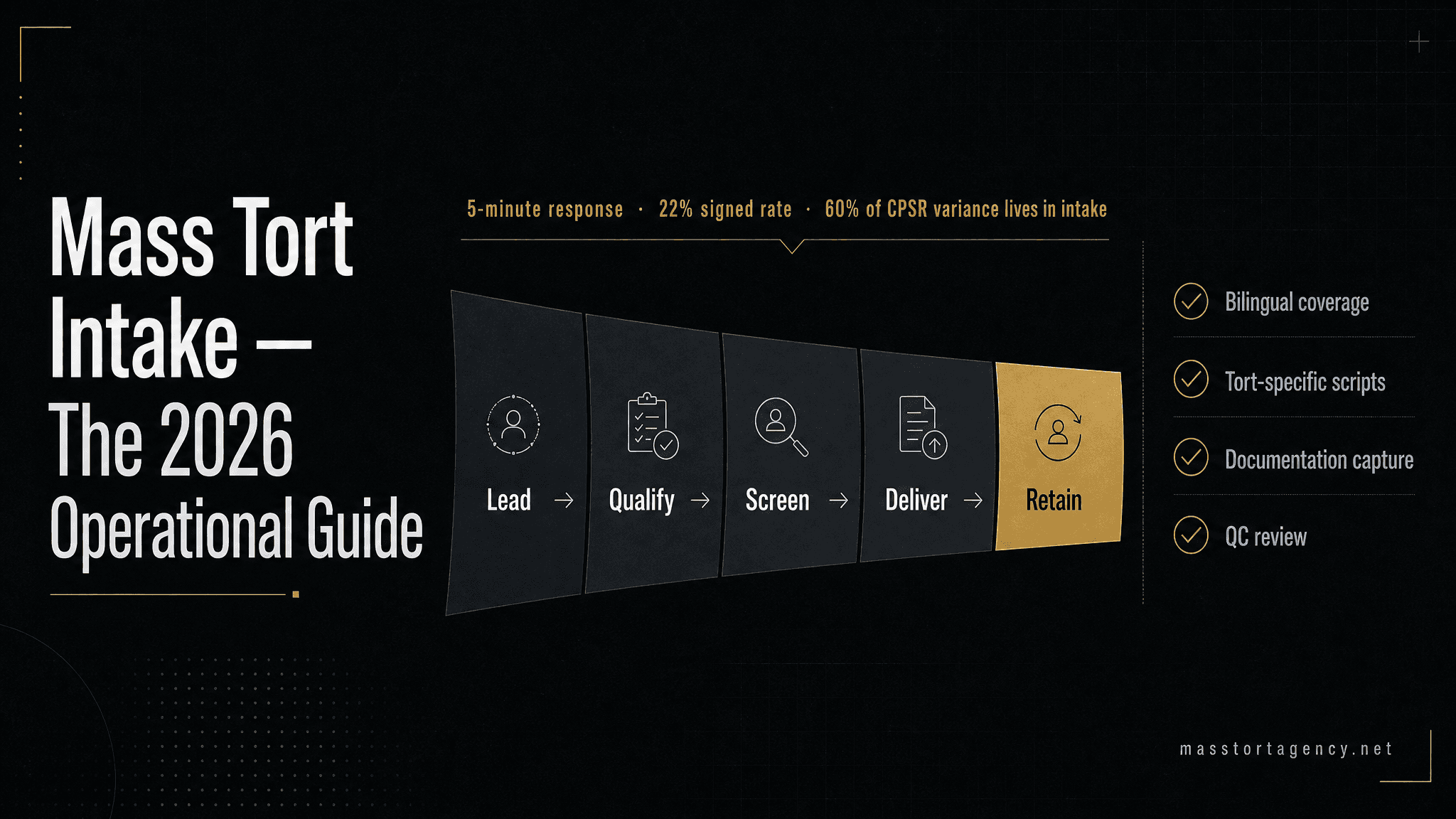
A well-structured mass tort intake call follows a predictable sequence. Each step serves a specific purpose, and skipping steps is how firms end up with unqualified retainers that waste litigation resources.
Step 1: Warm introduction and rapport (60-90 seconds)
The claimant called because they believe they were harmed. They may be anxious, confused, or skeptical. The first 90 seconds set the tone for the entire interaction. Introduce yourself by name, explain that you work with the law firm, and briefly describe why they are being contacted or why you are glad they called. Do not jump straight into screening questions.
Step 2: Exposure or injury verification (3-5 minutes)
This is the core of mass tort intake. Each tort has specific qualifying criteria that must be confirmed:
- Camp Lejeune: Were you stationed at or lived on Marine Corps Base Camp Lejeune between 1953 and 1987 for at least 30 days?
- Roundup: Did you regularly use Roundup or glyphosate-based herbicides? For how many years? Have you been diagnosed with Non-Hodgkin's lymphoma?
- Ozempic: Were you prescribed Ozempic, Wegovy, or another semaglutide medication? Did you develop gastroparesis, bowel obstruction, or severe gastrointestinal complications?
- AFFF: Were you a firefighter, military personnel, or airport worker who was exposed to aqueous film-forming foam? Have you been diagnosed with kidney, testicular, or other qualifying cancers?
The intake specialist must ask these questions in a way that elicits accurate, detailed answers without leading the claimant. Asking "You were diagnosed with cancer, right?" is leading. Asking "Have you received any medical diagnoses that you believe are related to this exposure?" is proper.
Step 3: Medical documentation request (2-3 minutes)
After confirming basic exposure and injury, request supporting documentation. For most mass torts, this includes medical records, diagnosis letters, imaging reports, prescription history, and any correspondence with healthcare providers. Explain clearly what you need, why you need it, and how to send it securely. HIPAA compliance is non-negotiable at this stage.
Step 4: Conflict and duplicate check (1-2 minutes)
Before proceeding to retainer, verify that the claimant has not already retained another attorney for this claim. Ask directly: "Have you spoken with or hired any other law firm about this matter?" Also run an automated deduplication check against your CRM. Signing a claimant who already has representation creates ethical violations and wastes resources.
Step 5: Retainer execution (2-3 minutes)
If the claimant qualifies, walk them through the retainer agreement. Use e-signature tools (DocuSign, HelloSign) for immediate execution. Explain the contingency fee structure, what the firm will do on their behalf, and the expected timeline. The faster you execute the retainer during the initial call, the higher your conversion rate — claimants who are told "we will send you paperwork later" drop off at rates above 40%.
Building your mass tort intake team
Who to hire
The best mass tort intake specialists are not necessarily former paralegals or legal professionals. They are empathetic communicators who can follow structured scripts while adapting to each claimant's emotional state. Look for candidates with:
- Call center or customer service experience (inbound preferred)
- Bilingual capability (English/Spanish covers 95% of the U.S. claimant population)
- Comfort with technology — CRM, e-signature, document management
- Ability to maintain composure during emotionally charged conversations
- Attention to detail for accurate data entry and criteria matching
How to train them
Training for mass tort intake should be tort-specific. Each litigation has different qualifying criteria, common claimant questions, and documentation requirements. Build a training program that includes:
- Tort-specific modules: One module per active tort covering exposure criteria, qualifying injuries, common objections, and documentation requirements.
- Call simulation: At least 20 hours of supervised mock calls before an agent handles live claimants.
- Compliance training: HIPAA, TCPA, state bar advertising rules, and ethical guidelines for non-attorney staff.
- Technology proficiency: Hands-on training with your CRM, phone system, e-signature platform, and reporting tools.
- Quality calibration: Weekly call reviews with scoring rubrics. Agents should know exactly what a "good" call sounds like.

The technology stack for mass tort intake
Running mass tort intake on spreadsheets and personal cell phones is how firms lose claimants. A proper technology stack includes:
| Category | Tools | Why it matters |
|---|---|---|
| Legal CRM | Litify, Filevine, Salesforce | Central claimant database, pipeline tracking, deduplication |
| Phone system | RingCentral, Five9, Genesys | Call routing, recording, IVR, real-time monitoring |
| E-signature | DocuSign, HelloSign | Same-call retainer execution — 40% drop-off if delayed |
| Document mgmt | NetDocuments, iManage | HIPAA-compliant storage for medical records |
| QA & analytics | CallRail, Invoca, custom dashboards | Call scoring, conversion tracking, agent performance |
CRM configuration for mass tort
Your CRM needs tort-specific intake forms with conditional logic. When a specialist selects "Camp Lejeune" as the tort type, the intake form should dynamically show Camp Lejeune-specific questions (dates of service, base location, diagnosed conditions). When they select "Hair Relaxer," different questions appear (product brands used, duration of use, cancer diagnosis). This conditional logic eliminates manual errors and ensures consistent screening.
Need a turnkey intake operation?
Mass Tort Agency provides fully managed intake services — trained specialists, 24/7 coverage, bilingual screening, and direct CRM integration. Your team focuses on litigation.
Talk to Our Intake TeamMeasuring intake performance: the metrics that matter
You cannot improve what you do not measure. These are the KPIs every mass tort firm should track weekly:
Lead-to-contact rate
What percentage of leads actually answer the phone or respond to outreach? Target: 65-80%. Below 50% means your speed-to-lead is too slow.
Contact-to-qualified rate
Of the claimants you reach, how many meet the tort criteria? Target: 40-60%. Below 30% means your lead source quality needs work.
Qualified-to-signed rate
Of qualified claimants, how many sign a retainer? Target: 70-85%. Below 60% means your retainer execution process is leaking.
Speed to first contact
How fast do you call a new lead? Target: under 5 minutes. After 30 minutes, conversion drops 50%. After 24 hours, it drops 90%.
Average handle time
How long is each intake call? Target: 12-18 minutes. Under 8 minutes means you are rushing screening. Over 25 means inefficiency.
Cost per signed retainer
Total intake cost (people + tech + overhead) divided by signed retainers. Benchmark against your lead cost to calculate true acquisition cost.
Speed to lead: the single biggest intake lever
Research from the Harvard Business Review and InsideSales.com consistently shows that the speed at which you contact a new lead is the strongest predictor of conversion. In mass tort specifically:
- Leads contacted within 5 minutes convert at 8x the rate of leads contacted after 30 minutes.
- Leads contacted within 1 hour are 7x more likely to have a meaningful conversation than leads contacted after 24 hours.
- After 24 hours, most mass tort leads have either called a competitor, forgotten why they inquired, or decided not to pursue the claim.
This is why 24/7 intake coverage is not a luxury — it is a mathematical necessity. A claimant who fills out a form at 11 PM on a Saturday will not wait until Monday morning for a callback. They will fill out three more forms on competitor sites and sign with whoever calls first.

In-house vs. outsourced intake: making the right call
When in-house intake works
In-house intake makes sense when your lead volume is under 50 per week, your tort portfolio is narrow (1-2 active torts), and you want direct control over the claimant experience. The advantages: your team knows your firm's voice, you can train them on nuances, and you maintain full quality control.
When outsourced intake wins
Outsourced intake wins when volume exceeds 50 leads per week, you need 24/7 coverage, you are adding new torts frequently, or you need bilingual capability. A specialized intake partner like Mass Tort Agency has trained specialists who already know the screening criteria for 16+ active torts, pre-built CRM integrations, and quality assurance processes that take months to build in-house.
| Factor | In-house | Outsourced |
|---|---|---|
| Setup time | 2-3 months | 1-2 weeks |
| Coverage | Business hours only (typically) | 24/7/365 |
| Bilingual | Requires specific hires | Built-in English/Spanish |
| Scaling | Hire → train → deploy (weeks) | Same-week volume increase |
| Cost at 200 leads/wk | $18K-$25K/mo (fully loaded) | $8K-$15K/mo |
Compliance considerations in mass tort intake
Mass tort intake sits at the intersection of several regulatory frameworks. Getting compliance wrong can result in bar sanctions, TCPA fines, or case dismissals.
- HIPAA: Any medical information collected during intake must be handled in a HIPAA-compliant manner. This includes secure storage, access controls, encryption in transit, and proper authorization forms before requesting medical records.
- TCPA: If you are contacting leads who submitted web forms, ensure you have proper consent documentation. TrustedForm certificates and TCPA-compliant consent language are table stakes.
- State bar rules: Non-attorney intake staff cannot provide legal advice. They can explain the intake process, collect information, and facilitate retainer execution — but they cannot advise claimants on the merits of their case.
- Call recording: Many states require two-party consent for call recording. Your IVR or intake script must include a recording disclosure that complies with the most restrictive state law applicable to your calls.
Ready to fix your intake conversion rate?
Our trained specialists screen claimants against your exact case criteria, 24 hours a day, in English and Spanish. Live transfer or CRM delivery — your choice.
Book a Strategy CallCommon intake mistakes that destroy conversion rates
Mistake 1: Slow follow-up
Waiting more than 5 minutes to contact a new lead cuts your conversion rate in half. Waiting 24 hours effectively kills it. If you cannot contact every lead within 5 minutes of submission, you need automated systems or an outsourced partner who can.
Mistake 2: Generic scripts
Using the same intake script for Camp Lejeune and NEC Baby Formula is like using the same deposition outline for a car accident and a medical malpractice case. Each tort requires specific screening questions, specific documentation, and specific empathy calibrations.
Mistake 3: Skipping the retainer on the first call
"We will send you the paperwork" is the most expensive sentence in mass tort intake. Over 40% of qualified claimants who are not signed during the initial call never execute the retainer. E-signature tools make same-call execution possible and should be standard for every intake interaction.
Mistake 4: No quality assurance
If you are not recording calls, scoring them, and reviewing at least 10% weekly, you have no idea how your intake team is performing. Bad habits compound silently until your conversion rate craters and you blame the lead source instead of the intake process.
Mistake 5: Treating intake as a cost center instead of a revenue driver
Intake is not overhead. It is the mechanism that converts marketing spend into signed cases. A firm that spends $100K on lead generation and $5K on intake is underinvesting in the function that determines whether that $100K produces 15 retainers or 45.
The future of mass tort intake: AI and automation
AI is beginning to transform mass tort intake in several ways:
- Predictive lead scoring: Machine learning models that analyze lead source, demographics, and engagement patterns to predict which leads are most likely to qualify and sign — allowing intake teams to prioritize high-value contacts.
- Automated pre-screening: Conversational AI that handles initial qualification questions via text or chat before routing qualified claimants to a human specialist for deeper screening and retainer execution.
- Real-time call coaching: AI tools that listen to intake calls in real time and surface prompts to the specialist — reminding them to ask missed screening questions or suggesting responses to common objections.
- Automated follow-up: Smart sequences that re-engage claimants who did not complete intake on the first contact, using personalized messaging timed to maximize callback rates.
These tools augment human intake specialists — they do not replace them. The empathy, judgment, and adaptability required to convert a hesitant claimant into a signed retainer remains a human skill. The firms that will win are the ones that give their human specialists the best AI-powered tools.
How intake fits into your overall mass tort acquisition strategy
Intake is one piece of a larger system. It sits between lead generation (the top of funnel) and case management (the back end). Optimizing intake in isolation produces limited results. The real gains come from optimizing the entire pipeline:
- Lead generation feeds intake. Low-quality leads produce low intake conversion regardless of how skilled your team is. Partner with a mass tort lead generation agency that pre-screens for basic eligibility before sending leads to your intake team.
- Intake feeds case management. A well-run intake process delivers retainers with complete documentation, accurate qualifying information, and realistic claimant expectations — reducing downstream friction for your litigation team.
- Case management feeds referrals. Claimants who have a positive experience with your firm become referral sources for additional claimants in the same tort — reducing your per-acquisition cost over time.
