

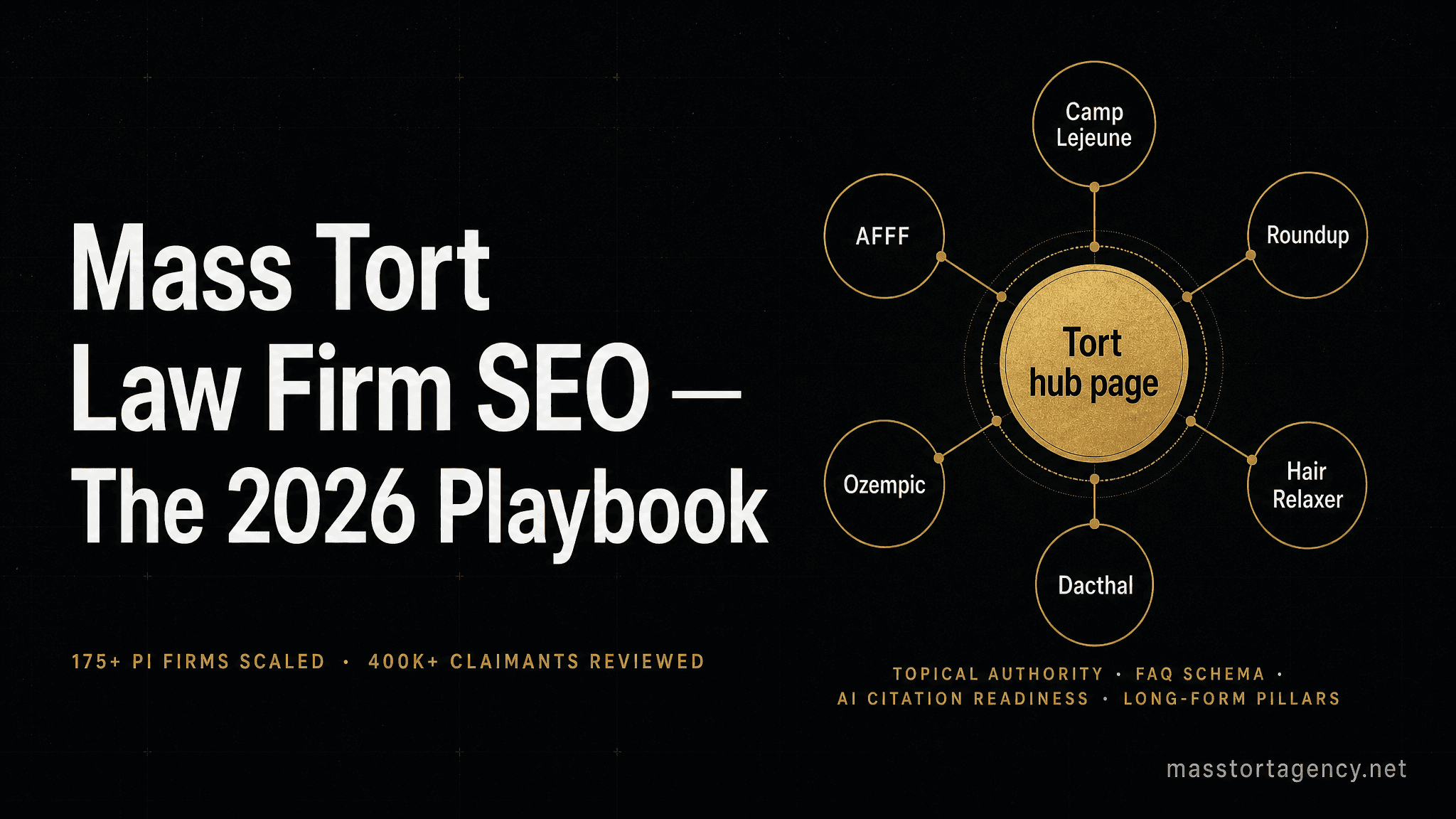
Why mass tort law firms need specialized SEO
Mass tort litigation operates on a fundamentally different economic model than traditional personal injury. A single-event PI case — a car accident, a slip-and-fall — involves one plaintiff, one defendant, and one set of facts. Mass torts aggregate hundreds or thousands of plaintiffs with similar injuries caused by the same product, chemical, or pharmaceutical. This aggregation model creates unique marketing dynamics that demand specialized search engine optimization strategies.
The economics are stark. A signed mass tort retainer can be worth $5,000 to $50,000 in attorney fees depending on the tort type, settlement tier, and common benefit fund allocation. Camp Lejeune cases have produced per-claimant settlements ranging from $25,000 to over $500,000. Roundup settlements have averaged $150,000 to $175,000 per plaintiff. At these values, even a modest organic search presence that generates 10 to 20 qualified leads per month can produce $500,000 to $2,000,000 in annual case revenue.
But the competitive landscape for mass tort keywords is among the most aggressive in all of digital marketing. Law firms, lead generation companies, and legal marketing agencies compete for the same high-intent search terms. Google Ads CPCs for terms like "Roundup lawsuit attorney" regularly exceed $150 to $300 per click. "Camp Lejeune lawyer" can cost $200 or more per click during peak advertising periods. These paid search costs make organic ranking not just valuable but economically essential for sustainable plaintiff acquisition.
Generic SEO strategies designed for local PI practices do not translate to mass tort. A local PI firm optimizes for "car accident lawyer [city]" — a geographically bounded, evergreen keyword with relatively stable search volume. Mass tort keywords are national in scope, time-sensitive (tied to litigation milestones, FDA actions, and settlement announcements), and subject to dramatic search volume fluctuations. A mass tort SEO strategy must account for these dynamics or risk investing months of work into rankings that deliver no return.
Consider the lifecycle of a mass tort keyword. When the first Ozempic lawsuitswere filed in 2023, search volume for "Ozempic lawsuit" was negligible — fewer than 500 monthly searches. By mid-2024, it exceeded 40,000 monthly searches. Firms that had published comprehensive Ozempic content early captured enormous organic traffic and signed thousands of cases. Firms that waited until the keyword was "proven" faced entrenched competitors and sky-high paid advertising costs. Mass tort SEO rewards early movers who can identify emerging torts, publish authoritative content before competition intensifies, and maintain rankings as the litigation matures.
This guide covers every dimension of mass tort law firm SEO — from keyword research and content architecture to technical optimization, link building, E-E-A-T compliance, and AI search readiness. Whether you are building an SEO program from scratch or optimizing an existing one, the strategies outlined here are drawn from real campaigns that have generated millions of dollars in signed case value for mass tort practices.
Mass tort SEO is not a marketing expense — it is a capital investment in a compounding asset. Every page you publish, every link you earn, and every technical improvement you make builds cumulative authority that reduces your cost per case over time.

The mass tort SEO landscape in 2026
The mass tort SEO landscape has evolved dramatically over the past several years. Understanding where we are in 2026 is essential for allocating resources effectively and avoiding strategies that worked in 2022 but are now obsolete or counterproductive.
Google AI Overviews and zero-click searches
Google's AI Overviews — the AI-generated summaries that appear at the top of many search results — have fundamentally changed click-through rates for informational queries. For a search like "what is the Camp Lejeune lawsuit," Google now provides a comprehensive AI-generated answer that satisfies many users without clicking through to any website. Studies from Semrush and Ahrefs indicate that AI Overviews have reduced organic CTR for informational legal queries by 15 to 30 percent.
However, high-intent transactional queries — "Camp Lejeune lawyer free consultation," "file a Roundup lawsuit," "do I qualify for Ozempic settlement" — are less affected because users need to take action, not just consume information. Mass tort SEO strategy in 2026 must prioritize these transactional and navigational queries while also optimizing content to be cited within AI Overviews for informational terms.
The rise of alternative search engines
ChatGPT, Perplexity, Copilot, and other AI-powered search tools now capture an estimated 8 to 12 percentof legal research queries. When a potential claimant asks Perplexity "can I sue over Ozempic side effects," the response cites specific web sources. If your content is among those cited sources, you receive traffic and brand exposure from an entirely new channel. Generative Engine Optimization (GEO) — optimizing content to be cited by AI search tools — is now a parallel discipline to traditional SEO for mass tort firms.
E-E-A-T enforcement for legal content
Google classifies legal content as Your Money or Your Life (YMYL), subjecting it to the highest quality standards. The March 2024 core update and the August 2025 helpful content system update hit legal websites particularly hard. Sites with thin, AI-generated practice area pages saw traffic drops of 30 to 60 percent. Sites with demonstrated attorney authorship, case experience, and original legal analysis saw traffic increases. Google's quality raters now specifically evaluate whether legal content is written or reviewed by licensed attorneys with relevant practice experience.
Link building has become harder and more important
Google's SpamBrain algorithm has become increasingly effective at identifying and devaluing manipulative link schemes. Guest post networks, PBNs (private blog networks), and mass directory submissions that worked in 2020 now carry penalty risk. Meanwhile, the correlation between high-quality backlinks and rankings has strengthened. Firms that earn editorial links from legal publications, news outlets, and authoritative health resources consistently outperform competitors with larger content libraries but weaker link profiles.
Core Web Vitals and page experience
Page speed, interactivity, and visual stability (the Core Web Vitals metrics) are confirmed ranking factors. Google's March 2024 update introduced Interaction to Next Paint (INP) as a replacement for First Input Delay, raising the bar for interactive elements like case evaluation forms, live chat widgets, and dynamic content. Law firm websites loaded with third-party scripts (chat tools, tracking pixels, retargeting tags) frequently fail INP thresholds, costing them rankings.
| Factor | 2022 Status | 2026 Status |
|---|---|---|
| AI search impact | Minimal | 15-30% CTR reduction on informational queries |
| E-E-A-T requirements | Important but loosely enforced | Critical for YMYL legal content |
| Content quality bar | 1,500-word pages could rank | 3,000+ word pillar pages required |
| Link building | Volume-based approaches viable | Quality-only; spam penalized aggressively |
| Page experience | Nice-to-have | Confirmed ranking factor with INP |
Keyword research for mass tort litigation
Keyword research for mass tort is fundamentally different from keyword research for local PI or general legal services. Mass tort keywords are characterized by volatility (search volumes spike and decline based on litigation milestones), national scope (claimants search from all 50 states), and high commercial intent (searchers are actively considering legal action). Understanding these dynamics is the foundation of every effective mass tort SEO campaign.
Primary keyword categories
Mass tort keywords fall into four distinct intent categories, each requiring different content and optimization approaches:
- Informational: "What is the Camp Lejeune lawsuit" / "Roundup cancer link" / "Ozempic side effects stomach paralysis." These queries indicate early-stage awareness. The searcher knows something is wrong but has not yet decided to pursue legal action. Content targeting these keywords should educate and build trust, with soft calls to action.
- Investigational: "Do I qualify for the Roundup lawsuit" / "Camp Lejeune settlement amounts" / "how much is an Ozempic lawsuit worth." These queries indicate active consideration. The searcher is evaluating whether they have a viable claim. Content should address qualification criteria, settlement ranges, and the litigation timeline.
- Transactional: "Roundup lawsuit attorney" / "Camp Lejeune lawyer free consultation" / "file Ozempic lawsuit." These queries indicate intent to hire an attorney. Content should feature strong calls to action, case evaluation forms, and trust signals like verdicts, settlements, and client testimonials.
- Navigational: "[Firm name] mass tort" / "[Firm name] Camp Lejeune." These queries indicate brand-aware searchers who already know your firm. Ensure your site ranks for branded terms and that landing pages match brand search intent.
Tools for mass tort keyword research
Effective mass tort keyword research requires multiple data sources because no single tool captures all search demand accurately:
- Ahrefs: Best for keyword difficulty scores, SERP analysis, and competitor keyword gap analysis. The "Matching terms" report is particularly useful for discovering long-tail variations of core tort keywords.
- SEMrush: Strongest for tracking keyword trends over time and identifying seasonal patterns. The "Keyword Magic Tool" excels at building comprehensive keyword lists organized by intent.
- Google Search Console: The only source of actual click and impression data for your own site. Essential for identifying keywords where you already rank on page 2 (positions 11-20) and can push to page 1 with targeted optimization.
- Google Trends: Critical for tracking mass tort search interest over time. When a new tort emerges (like the Zantac or NEC lawsuits), Google Trends shows the trajectory before keyword tools register meaningful volume.
- AnswerThePublic / AlsoAsked: Generate question-based keywords that map directly to FAQ content and People Also Ask optimization.
- Screaming Frog: While primarily a crawler, its integration with Search Console and Ahrefs data makes it invaluable for mapping existing keyword coverage and identifying content gaps.
Search volume trends for active torts
Understanding search volume patterns helps allocate content production resources effectively. Here are current monthly search volumes for major mass tort keywords as of Q1 2026:
| Keyword | Monthly volume | CPC | Keyword difficulty |
|---|---|---|---|
| Camp Lejeune lawsuit | 74,000 | $185 | 82 |
| Roundup lawsuit | 49,500 | $165 | 78 |
| Ozempic lawsuit | 40,500 | $142 | 71 |
| AFFF lawsuit | 18,100 | $178 | 68 |
| NEC baby formula lawsuit | 12,100 | $125 | 59 |
| Hair relaxer lawsuit | 8,100 | $98 | 54 |
Notice the correlation between search volume and CPC — the most-searched tort keywords also command the highest advertising costs, which directly validates the ROI of organic ranking. A page-one ranking for "Camp Lejeune lawsuit" delivers the equivalent of $500,000+ per month in paid search valuebased on the keyword's volume and CPC.
Building a tort-specific keyword taxonomy
A keyword taxonomy is a structured hierarchy that maps every relevant keyword to a specific page on your site. Without a taxonomy, firms inevitably create competing pages that cannibalize each other's rankings — one of the most common and destructive mass tort SEO mistakes.
For each mass tort your firm handles, build a three-tier keyword structure:
Tier 1: Pillar keywords (assigned to main tort page)
These are the highest-volume, most competitive terms. Each should map to a single comprehensive pillar page. Examples for a Roundup campaign:
- "Roundup lawsuit" (49,500/mo)
- "Roundup cancer lawsuit" (22,200/mo)
- "Roundup attorney" (6,600/mo)
- "Roundup settlement" (33,100/mo)
Tier 2: Cluster keywords (assigned to supporting blog posts)
These are moderate-volume keywords that support the pillar page through internal linking. Each gets its own dedicated blog post or supporting page:
- "Roundup lawsuit settlement amounts 2026" (2,400/mo)
- "Does Roundup cause non-Hodgkin lymphoma" (1,900/mo)
- "Roundup lawsuit eligibility requirements" (1,600/mo)
- "Roundup lawsuit update today" (3,600/mo)
- "How to file a Roundup lawsuit" (880/mo)
Tier 3: Long-tail keywords (addressed within existing content)
These low-volume, low-competition terms are addressed as subsections within pillar or cluster content rather than standalone pages:
- "Can I sue Roundup if I used it 10 years ago" (210/mo)
- "Roundup lawsuit statute of limitations California" (170/mo)
- "Roundup settlement per person after lawyer fees" (140/mo)
- "Is the Roundup lawsuit still open for new cases" (320/mo)
Document your taxonomy in a spreadsheet with columns for: keyword, monthly volume, keyword difficulty, assigned page URL, intent type (informational/investigational/transactional), and content status (published/drafted/planned). This becomes your SEO content roadmap and prevents the duplicate-content and cannibalization issues that plague most legal sites.
Avoiding keyword cannibalization
Keyword cannibalization occurs when multiple pages on your site target the same primary keyword, causing Google to split ranking signals and rank neither page as highly as a single consolidated page would. This is rampant on mass tort law firm websites. Common examples include having both a "practice area" page and a "blog post" targeting "Camp Lejeune lawsuit" — Google does not know which to rank, so both suffer.
The fix is strict keyword-to-URL mapping. One primary keyword per page, documented in your taxonomy. When you discover existing cannibalization, consolidate the competing pages into a single authoritative page and 301-redirect the redundant URL to the consolidated version. Use Google Search Console's Performance report filtered by query to identify pages competing for the same keywords.
On-page SEO for mass tort practice pages
On-page optimization for mass tort pages requires balancing search engine requirements with conversion optimization. Each tort-specific landing page is simultaneously a ranking asset and a lead generation tool. Getting the balance wrong — too SEO-heavy and the page does not convert; too conversion-focused and the page does not rank — is one of the most common failures in legal SEO.
Title tag optimization
Title tags remain the single most impactful on-page ranking factor. For mass tort pages, follow this formula:
- Primary keyword first: "Camp Lejeune Lawsuit — Free Case Review | [Firm Name]"
- Include a value proposition: "Free consultation," "no fee unless you win," or a specific settlement figure
- Keep it under 60 characters: Google truncates titles beyond this length
- Differentiate from competitors: Most firms use identical title formulas. Include a unique element like a specific verdict amount or years of experience
Meta description optimization
Meta descriptions do not directly impact rankings but significantly affect click-through rates — which indirectly impacts rankings. Write descriptions that:
- Include the primary keyword naturally within the first 100 characters
- Contain a clear call to action ("Get your free case evaluation today")
- Reference a specific trust signal (settlement amounts, years of experience, number of cases handled)
- Stay under 155 characters to avoid truncation in search results
Header structure and content hierarchy
Google uses header tags (H1 through H6) to understand content structure and topical coverage. For a mass tort pillar page, use this heading structure:
- H1: One per page. Include the primary keyword. Example: "Camp Lejeune Water Contamination Lawsuit: Your Complete Guide"
- H2: Major sections covering distinct subtopics. Each H2 should target a related keyword. Examples: "Who Qualifies for the Camp Lejeune Lawsuit," "Camp Lejeune Settlement Amounts," "How to File a Camp Lejeune Claim"
- H3: Subsections within each H2. These target long-tail variations and provide detailed coverage that differentiates your page from competitors
Content depth and comprehensiveness
Google's helpful content system evaluates whether a page provides a "substantially complete" answer to the searcher's query. For mass tort pages, this means covering:
- The scientific or medical basis for the tort (what the product does, how it causes harm)
- Specific qualification criteria (exposure timeframes, diagnosed conditions, geographic requirements)
- The litigation timeline and current status (MDL proceedings, bellwether trials, settlement negotiations)
- Settlement ranges with specific examples from the specific tort
- The legal process from initial consultation through resolution
- Statute of limitations information by jurisdiction
- Frequently asked questions addressing common claimant concerns
Comprehensive pillar pages for mass torts should be 3,000 to 8,000 words. Analysis of pages ranking in positions 1-3 for competitive mass tort keywords shows an average word count of 4,200 words. Pages under 1,500 words almost never rank on page one for primary tort keywords.
Internal linking strategy
Internal links distribute ranking authority (PageRank) throughout your site and help Google understand content relationships. For mass tort SEO, implement a hub-and-spoke internal linking model:
- The tort pillar page (hub) links to all supporting content (spokes): blog posts, FAQ pages, settlement updates, eligibility guides
- Every supporting page links back to the pillar page using keyword-rich anchor text
- Related tort pages link to each other where topically relevant (a Roundup page might link to a general "herbicide litigation" resource)
- Navigation and footer links ensure pillar pages are no more than 2 clicks from the homepage
Need SEO-optimized mass tort landing pages?
Mass Tort Agency builds high-converting, search-optimized campaign pages for every active tort. Pre-built content architecture, schema markup, and conversion optimization included.
Explore SEO ServicesContent strategy: pillar pages and topic clusters
The topic cluster model is the foundation of modern mass tort content strategy. Rather than publishing isolated blog posts that compete with each other and lack structural coherence, topic clusters organize content into interconnected ecosystems that signal topical authority to Google.
What is a topic cluster?
A topic cluster consists of three elements:
- Pillar page: A comprehensive, 3,000 to 8,000-word resource targeting the primary keyword for a specific tort. This page provides broad coverage of every aspect of the topic.
- Cluster content: Supporting blog posts, each targeting a specific long-tail keyword or subtopic. Each cluster post covers one narrow aspect of the tort in greater depth than the pillar page.
- Hyperlinks: Every cluster post links to the pillar page (and vice versa) using contextual anchor text. This interlinking signals to Google that the pillar page is the authoritative hub for the entire topic.
Building a cluster for Camp Lejeune
Here is a real example of a topic cluster architecture for Camp Lejeune litigation:
- Pillar page: "Camp Lejeune Water Contamination Lawsuit: Complete Guide" — targets "Camp Lejeune lawsuit" (74,000/mo)
- Cluster post 1: "Camp Lejeune Settlement Amounts: What Claimants Can Expect" — targets "Camp Lejeune settlement amounts" (18,100/mo)
- Cluster post 2: "Camp Lejeune Diseases: Complete List of Qualifying Conditions" — targets "Camp Lejeune qualifying conditions" (5,400/mo)
- Cluster post 3: "Camp Lejeune Lawsuit Update 2026: Latest Developments" — targets "Camp Lejeune lawsuit update" (8,100/mo)
- Cluster post 4: "PACT Act and Camp Lejeune: How the Law Changed Everything" — targets "PACT Act Camp Lejeune" (2,900/mo)
- Cluster post 5: "Camp Lejeune Statute of Limitations: Filing Deadlines Explained" — targets "Camp Lejeune deadline" (3,600/mo)
- Cluster post 6: "Camp Lejeune Water Testing Results: What the Data Shows" — targets "Camp Lejeune water contamination evidence" (1,200/mo)
This cluster targets over 113,000 monthly searches across seven pages, all channeling authority back to the pillar page. Firms implementing this model have seen 40 to 80 percent increases in organic traffic within 6 months compared to having the same content published as isolated pages.
Content formats that drive mass tort leads
Different content formats serve different stages of the claimant journey and different keyword intents:
Pillar guides
Comprehensive 3,000-8,000 word resources targeting primary tort keywords. Highest ranking potential and link-earning capability.
Settlement updates
Time-sensitive articles covering new settlement tiers, bellwether verdicts, and MDL developments. Drive recurring traffic from existing claimants and attorneys.
Eligibility checklists
Interactive or structured content helping potential claimants determine if they qualify. Highest conversion rate of any content type.
Scientific explainers
Deep dives into the medical or scientific evidence linking the product to injury. Build E-E-A-T signals and earn academic/medical backlinks.
FAQ compilations
Structured Q&A pages optimized for People Also Ask and FAQ schema markup. Low effort, high ranking potential for question-based queries.
Video case studies
Attorney commentary on litigation strategy, client testimonials (with consent), or expert interviews. Increase time on page by 40-60% when embedded in written content.
Technical SEO audit checklist for law firms
Technical SEO ensures that Google can efficiently crawl, index, and render your website. For mass tort law firms, technical issues are surprisingly common — many legal websites are built on outdated CMS platforms, loaded with unnecessary plugins, and never audited for technical health. A comprehensive technical audit should be performed quarterly using tools like Screaming Frog, Sitebulb, or Lumar, supplemented by Google Search Console data.
Crawlability and indexation
- robots.txt: Verify that no important pages are blocked. A common mistake is blocking /wp-admin/ or /api/ routes that contain resources needed for rendering.
- XML sitemap: Submit a dynamically generated sitemap to Google Search Console. Include only indexable pages (200 status, no noindex). Exclude paginated archives, tag pages, and parameter URLs.
- Crawl budget: For sites with 500+ pages, monitor crawl stats in Search Console. Eliminate redirect chains (more than one hop), fix 404 errors, and reduce duplicate content to ensure Googlebot spends its crawl budget on pages that matter.
- Index coverage: Check Search Console's Pages report weekly. Investigate any pages showing "Crawled — currently not indexed" or "Discovered — currently not indexed" status, as these indicate quality or crawlability issues.
- Canonical tags: Every page should have a self-referencing canonical tag. If you have duplicate or near-duplicate content (common with location-specific tort pages), use canonicals to designate the preferred version.
Site architecture and URL structure
- URL hierarchy: Use clean, descriptive URLs that reflect your site structure. Good: /mass-tort/camp-lejeune/ or /practice-areas/camp-lejeune-lawsuit/. Bad: /page?id=347 or /2024/01/camp-lejeune-post/.
- Click depth: No important page should be more than 3 clicks from the homepage. Mass tort pillar pages should be accessible from the main navigation (1 click).
- Breadcrumb navigation: Implement breadcrumbs with BreadcrumbList schema markup. This improves both user navigation and search result appearance.
- Faceted navigation: If your site has filters (by tort type, state, injury type), ensure faceted URLs are either canonicalized or blocked from indexing to prevent index bloat.
HTTPS and security
- All pages must serve over HTTPS. Mixed content (HTTP resources on HTTPS pages) must be eliminated.
- Implement HSTS headers to prevent protocol downgrade attacks.
- Ensure your SSL certificate is valid, not expired, and covers all subdomains in use.
- Google has confirmed HTTPS as a ranking signal since 2014, and Chrome labels HTTP pages as "Not Secure" — a trust killer for legal websites where visitors are sharing sensitive medical information.
Mobile responsiveness
- Google uses mobile-first indexing — your mobile experience is your primary ranking factor.
- Test every page type (homepage, tort landing page, blog post, contact page) using Google's Mobile-Friendly Test and Chrome DevTools device emulation.
- Common mobile issues on legal sites: case evaluation forms that are too wide, text that requires horizontal scrolling, tap targets (buttons, links) that are too close together, and pop-up interstitials that block content.
Redirect management
- Use 301 (permanent) redirects for pages that have moved permanently. Use 302 (temporary) only for genuinely temporary situations.
- Eliminate redirect chains (A redirects to B redirects to C). Each hop loses approximately 15 percent of passed link equity.
- After a site migration or URL restructure, monitor 404 errors in Search Console for at least 90 days and implement redirects for any high-traffic orphaned URLs.
Core Web Vitals and page experience signals
Core Web Vitals measure real-user experience across three dimensions: loading performance, interactivity, and visual stability. As of 2026, these metrics are confirmed ranking factors that increasingly differentiate otherwise-equal pages in competitive legal SERPs. Law firm websites — often bloated with live chat widgets, retargeting pixels, call tracking scripts, and heavy imagery — are disproportionately affected.
Largest Contentful Paint (LCP)
LCP measures how quickly the largest visible content element loads — typically a hero image or heading text block. Google's threshold: under 2.5 secondsfor a "good" score.
Common LCP issues on legal sites and their fixes:
- Unoptimized hero images: Compress images to WebP format. A 2MB JPEG hero image that takes 4 seconds to load can be reduced to a 150KB WebP that loads in under 1 second. Use responsive image srcsets to serve appropriately sized images for each device.
- Render-blocking resources: Defer non-critical CSS and JavaScript. Move third-party scripts (chat, analytics, tracking) to load asynchronously after the main content renders.
- Slow server response time: Use a CDN (Cloudflare, Fastly, AWS CloudFront) to serve static assets from edge locations. Upgrade hosting if TTFB exceeds 600ms. Consider a static site generator or headless CMS for content-heavy legal sites.
Interaction to Next Paint (INP)
INP replaced First Input Delay in March 2024 as the interactivity metric. It measures the latency of all user interactions (clicks, taps, key presses) throughout the entire page visit, not just the first interaction. Google's threshold: under 200 milliseconds.
Legal sites frequently fail INP due to:
- Heavy JavaScript on form interactions: Case evaluation forms with complex validation logic, conditional fields, and real-time API calls can cause input delays exceeding 500ms. Optimize by debouncing input handlers and moving validation to the server side.
- Third-party script main-thread blocking: Live chat widgets (Intercom, Drift, LiveChat) are the single biggest INP offender on legal websites. Load these scripts after initial page interaction or use lightweight alternatives.
- Long-running JavaScript tasks: Analytics scripts, retargeting pixels, and A/B testing tools can block the main thread for hundreds of milliseconds. Use web workers for heavy computation and prioritize critical rendering path scripts.
Cumulative Layout Shift (CLS)
CLS measures unexpected visual movement of page content. Google's threshold: under 0.1. Users who are reading a case evaluation form and suddenly have the form jump because an ad or image loaded above it will likely bounce.
- Always specify width and height attributes on images (or use CSS aspect-ratio) to reserve space before images load
- Reserve space for dynamically injected elements (chat widgets, notification bars, cookie consent banners) using fixed positioning or pre-allocated containers
- Avoid inserting content above existing content after page load — a common issue with lazy-loaded related articles or "floating" CTA bars

Schema markup for legal services
Schema markup (structured data) helps search engines understand the context and relationships within your content. For mass tort law firms, proper schema implementation can earn rich results in Google — star ratings, FAQ dropdowns, breadcrumbs, and knowledge panel information — that dramatically improve click-through rates from search results.
Essential schema types for mass tort sites
- LegalService schema: Applied to your homepage and firm-level pages. Includes business name, address, phone, areas of practice, founding date, attorney profiles, and aggregate rating. This powers your Google Knowledge Panel.
- Attorney schema (Person): Applied to individual attorney bio pages. Include name, credentials, bar admissions, education, areas of practice, and links to professional profiles (LinkedIn, state bar listings).
- FAQPage schema: Applied to any page containing FAQ-formatted content. This can display your questions and answers directly in search results, significantly increasing SERP real estate. Critical for mass tort pages where claimants have specific qualifying questions.
- Article schema: Applied to blog posts and editorial content. Include headline, author (linked to Person schema), date published, date modified, and publisher (linked to Organization schema).
- BreadcrumbList schema: Applied to every page with breadcrumb navigation. Displays a hierarchical path in search results (Home > Mass Torts > Camp Lejeune).
- Review/AggregateRating schema: Applied to pages displaying client testimonials or third-party reviews. Displays star ratings in search results. Note: Google's guidelines restrict self-serving review markup, so use only legitimate third-party reviews from Google, Avvo, or similar platforms.
Implementation best practices
Use JSON-LD format (recommended by Google) rather than Microdata or RDFa. Place the JSON-LD script in the page's head or body — it does not need to be rendered visually. Validate all markup using Google's Rich Results Test and monitor performance in Search Console's Enhancements reports.
A common mistake is implementing schema markup that does not match the visible page content. Google's guidelines state that structured data must "represent the content of the page." Adding FAQ schema for questions not actually displayed on the page, or Review schema for fabricated testimonials, can result in a manual action penalty that removes your site from search results entirely.
Schema for mass tort practice pages specifically
For each tort-specific page, layer multiple schema types:
- WebPage schema with specialization indicating the legal topic
- FAQPage schema wrapping the qualification Q&A section
- BreadcrumbList schema for navigation context
- LegalService schema with areaServed listing jurisdictions where the firm takes cases
- Speakable schema on key paragraphs to optimize for voice search and Google Assistant queries about the tort
Local SEO for multi-jurisdiction mass tort firms
Mass torts are inherently national — plaintiffs across all 50 states may qualify. But claimants search locally. Approximately 46 percent of all Google searches have local intent, and legal queries over-index on this trend. "Camp Lejeune lawyer near me," "Roundup attorney in [city]," and "mass tort law firm [state]" are all high-volume, high-conversion queries that require local SEO optimization.
Google Business Profile optimization
Your Google Business Profile (GBP) is the foundation of local SEO. For mass tort firms operating in multiple jurisdictions, the approach depends on your physical presence:
- Single-office firms: Optimize one GBP listing thoroughly. Complete every field: business description (include tort types), categories (Personal Injury Attorney, Mass Tort Attorney), attributes, photos, and regular Google Posts about litigation updates.
- Multi-office firms: Create a GBP listing for each physical office. Each listing must have a unique address, local phone number, and location-specific description. Avoid duplicating content across listings.
- Virtual offices and service areas: Google allows service-area businesses without a physical address, but these listings are less competitive in the local pack. If local SEO is a priority, invest in physical office space in key markets.
Location-specific landing pages
Create dedicated landing pages for each state or metro area where you actively solicit mass tort cases. These pages should include:
- State-specific legal context (statute of limitations, state-specific regulations, local court information)
- Jurisdiction-specific case studies or settlement examples
- Local office information (address, phone, office hours) if applicable
- Embedded Google Map showing office location or service area
- Content that is genuinely unique — not just the same page with the city name swapped in. Google penalizes doorway pages that provide no unique value beyond geographic targeting.
Citation building and NAP consistency
Citations are mentions of your firm's Name, Address, and Phone number (NAP) across the web. Consistent NAP across all directories, legal listings, and social profiles is a core local ranking factor. Inconsistencies — even minor ones like "Suite 200" vs. "Ste. 200" — can split signals and reduce local ranking performance.
Priority citation sources for mass tort firms:
- Legal directories: Avvo, FindLaw, Justia, Martindale-Hubbell, Super Lawyers, Lawyers.com
- General directories: Yelp, BBB, Yellow Pages, Manta
- Data aggregators: Data Axle (InfoUSA), Localeze, Foursquare
- Social profiles: LinkedIn Company Page, Facebook Business Page, X (Twitter) Profile
Use a citation management tool like BrightLocal, Whitespark, or Yext to audit existing citations, correct inconsistencies, and build new citations at scale. A typical mass tort firm should maintain 80 to 120 accurate citations.
Review generation and management
Google reviews are the strongest local ranking factor outside of GBP optimization and proximity. Mass tort firms face a unique challenge: case confidentiality and ethical rules restrict client testimonial solicitation in many jurisdictions. Navigate this by:
- Requesting reviews from clients whose cases have concluded and who consent to public reviews
- Focusing review requests on service quality and communication rather than case outcomes
- Responding professionally to every review — positive and negative — to demonstrate engagement
- Complying with state bar rules on testimonials and endorsements (these vary significantly by jurisdiction)
Link building strategies for legal authority
Backlinks remain the strongest off-page ranking factor in Google's algorithm. For mass tort law firms operating in the most competitive legal verticals, link building is not optional — it is the primary differentiator between page-one rankings and page-three obscurity. However, the approach must be strategic and quality-focused. A single editorial link from a major news outlet or legal publication can deliver more ranking value than 100 directory submissions.
Digital PR and newsworthy content
The highest-value links come from editorial coverage in news publications, legal industry outlets, and health/science media. Mass tort firms have a natural advantage here because tort litigation is inherently newsworthy — settlements, verdicts, FDA actions, and scientific studies all generate media interest.
- Press releases: Distribute newsworthy updates (new lawsuit filings, settlement announcements, firm expansions) through PR Newswire or BusinessWire. Target legal and health beat reporters at major outlets.
- Expert commentary: Position your attorneys as sources for reporters covering mass tort developments. Register on HARO (Help a Reporter Out), Connectively, and Qwoted. Respond within hours to relevant queries with concise, quotable commentary.
- Original research: Publish original data or analysis that journalists can cite. Examples: analysis of settlement trends across torts, surveys of claimant experiences, or compilations of adverse event reports from FDA databases. Original research earns links from publications that no amount of outreach can replicate.
Legal publication guest authorship
Attorneys contributing substantive articles to legal publications earn authoritative backlinks while simultaneously building E-E-A-T signals. Priority publications include:
- Tier 1 (highest authority): Law360, The National Law Journal, Reuters Legal, American Bar Association Journal, Harvard Law Review Blog
- Tier 2 (strong authority): Lexology, JD Supra, Law.com, Mass Tort Nexus, DRI publications
- Tier 3 (moderate authority): State bar publications, local legal newspapers, specialty tort publications
Do not confuse guest authorship with "guest posting" on low-quality blogs created solely for link building purposes. Google explicitly penalizes the latter. Legitimate guest authorship involves substantive legal analysis published on established editorial platforms with real readership.
Resource link building
Create resources on your site so valuable that other sites link to them naturally. For mass tort firms, these include:
- Settlement trackers: Maintain a regularly updated page tracking settlement amounts, tiers, and payment timelines for each tort. Journalists, claimants, and other attorneys will link to this as a reference.
- Litigation timelines: Visual or text-based timelines of major litigation milestones (filing dates, MDL orders, bellwether trials, settlement announcements) that serve as canonical references for the tort.
- Scientific evidence summaries: Comprehensive summaries of the medical evidence linking products to injuries, citing peer-reviewed studies and FDA findings. Health and science writers often link to well-organized evidence compilations.
- Qualification tools: Interactive eligibility checkers that help potential claimants determine if they qualify. These earn links from consumer advocacy sites, support forums, and health information platforms.
Broken link building
Identify broken links on authoritative legal and health websites using Ahrefs or Screaming Frog. When you find a broken link that pointed to content similar to yours (a defunct law firm's mass tort page, a removed news article), reach out to the linking site and suggest your content as a replacement. This technique works particularly well in the legal space because law firm mergers, closures, and website redesigns constantly create broken links on high-authority legal directories.
Links to avoid
Google's SpamBrain algorithm is highly effective at detecting manipulative link patterns. The following link sources carry penalty risk and should be avoided:
- Private blog networks (PBNs) — networks of low-quality sites created solely for linking
- Paid links without nofollow/sponsored attributes
- Mass directory submissions to low-quality, non-vetted directories
- Comment spam on blogs, forums, or social media
- Link exchanges ("I'll link to you if you link to me") when done at scale
- Foreign-language or topically irrelevant links from sites with no connection to legal services
E-E-A-T optimization for legal content
E-E-A-T — Experience, Expertise, Authoritativeness, and Trustworthiness — is Google's quality framework for evaluating content, especially in YMYL (Your Money or Your Life) categories. Legal content is definitively YMYL, meaning Google holds it to the highest E-E-A-T standards. Failing to demonstrate E-E-A-T is the primary reason legal content does not rank despite being technically optimized and well-written.
Experience signals
Google's addition of "Experience" to the original E-A-T framework specifically rewards content created by practitioners with firsthand experience. For mass tort law firms, this means:
- Case narratives: Describe (within ethical bounds) the types of cases you have handled, the challenges you encountered, and the outcomes you achieved. Not specific client details — but patterns, strategies, and lessons learned from actual practice.
- Process descriptions: Walk through what the litigation process actually looks like from the attorney's perspective. How do you evaluate a potential Camp Lejeune claim? What medical records do you request? How do you work with medical experts? This practitioner-level detail signals genuine experience.
- First-person perspective: Content written in the attorney's voice ("In our experience handling NEC cases, the most common challenge is...") scores higher on experience signals than generic third-person legal writing.
Expertise signals
- Author bylines: Every piece of content should have a named author who is a licensed attorney. Include the author's bar number, practice areas, and years of experience.
- Author pages: Create detailed bio pages for each contributing attorney. Link to state bar verification, published articles, speaking engagements, professional memberships, and education credentials. Implement Person schema markup on these pages.
- Medical/scientific reviewer: For content discussing the health effects of products (Roundup and cancer, Ozempic and gastroparesis), having content reviewed by a medical professional and noting "Medically reviewed by [Name], MD" adds a significant expertise signal.
- Depth of analysis: Surface-level content that could be written by anyone without legal training fails the expertise test. Include specific legal concepts (MDL procedures, Daubert challenges, bellwether trial strategies), reference specific case law, and provide analysis that demonstrates genuine legal expertise.
Authoritativeness signals
- External mentions: Being cited by other authoritative legal sources, mentioned in news coverage, or referenced in legal publications all signal authority. Digital PR efforts directly build authoritativeness.
- Awards and recognition: Display legitimate professional recognition (Super Lawyers, Best Lawyers, state bar awards) prominently on your site with links to the awarding organization's verification page.
- Professional memberships: AAJ (American Association for Justice), state trial lawyers associations, Mass Tort Made Perfect, HarrisMartin, and other professional affiliations signal industry involvement.
- Case results: Published verdicts and settlements (where ethically permitted) demonstrate real-world authority. Include case type, jurisdiction, outcome, and any novel legal theories involved.
Trustworthiness signals
- Transparency: Clear attorney identification, physical office addresses, phone numbers, and bar admission information. Anonymous legal content is a major trustworthiness red flag.
- Disclaimers and disclosures: Attorney advertising disclaimers, no-guarantee disclaimers, and jurisdictional limitations must be prominently displayed, not buried in 8-point footer text.
- Secure site: HTTPS, privacy policy, terms of service, and clear data handling practices.
- Review profiles: Google reviews, Avvo ratings, BBB accreditation, and Martindale-Hubbell peer reviews all serve as third-party trust verification.
- Content accuracy: Ensure all legal information is current and accurate. Outdated statute of limitations information, incorrect settlement figures, or superseded legal analysis damages trustworthiness and can trigger quality rater downgrades.
Ready to build your mass tort SEO engine?
Mass Tort Agency provides turnkey SEO strategy, content production, and technical optimization specifically designed for mass tort plaintiff acquisition. From keyword research to link building, we handle it all.
Schedule a Strategy CallContent velocity: publishing cadence for mass tort
Content velocity — the rate at which you publish new content — directly impacts how quickly you build topical authority and how effectively you capture emerging keyword opportunities. Mass tort firms face a unique challenge: they must publish at sufficient velocity to compete while maintaining the quality standards that Google's E-E-A-T framework demands.
Recommended publishing cadence
Based on analysis of top-ranking mass tort law firm websites, here are the content velocity benchmarks that correlate with strong organic performance:
- Firms targeting 1-2 torts: 4 to 8 new pages per month (2 pillar/cluster pages + 2-6 blog posts/updates)
- Firms targeting 3-5 torts: 8 to 16 new pages per month, distributed across tort clusters
- Firms targeting 6+ torts: 16 to 30+ pages per month, requiring a dedicated content team or agency partnership
Quality always trumps quantity. Publishing 4 comprehensive, attorney-reviewed articles per month will outperform 20 thin, AI-generated posts. Google's helpful content system evaluates your site holistically — a high volume of low-quality content drags down the ranking performance of your good content.
Content production workflow
An efficient mass tort content production pipeline includes these stages:
- Keyword and topic identification (SEO strategist): Identify target keyword, search intent, competitive landscape, and content format
- Content brief creation (SEO strategist): Detailed outline with target keyword, secondary keywords, header structure, competitor analysis, and specific points to cover
- First draft (writer with legal knowledge): Draft the full article following the brief. Writers should have legal or medical writing experience; general freelance writers consistently fail the depth requirements for YMYL legal content
- Attorney review (practicing attorney): Review for legal accuracy, add practitioner-level insights, and ensure ethical compliance. This step is non-negotiable for E-E-A-T.
- SEO optimization (SEO specialist): Verify keyword placement, internal linking, meta tags, header structure, and schema markup
- Publication and promotion (marketing team): Publish, submit to Google for indexing, promote through social and email channels
- Performance monitoring (analytics/SEO team): Track rankings, traffic, and conversions for 90 days post-publication. Update or expand content that underperforms.
Content refresh strategy
Mass tort content decays faster than evergreen legal content because litigation developments constantly change the factual landscape. A content refresh strategy ensures existing pages maintain their rankings:
- Monthly updates: Settlement update pages, litigation status pages, and any content referencing specific dates, amounts, or case status
- Quarterly reviews: Pillar pages, practice area pages, and top-performing blog posts. Update statistics, add new sections addressing emerging questions, and refresh internal links
- Annual overhauls: Comprehensive reviews of all indexed content. Consolidate or prune low-performing pages, update title tags and meta descriptions, and ensure all content reflects current legal landscape
Measuring SEO ROI for mass tort campaigns
Measuring SEO ROI for mass tort campaigns requires connecting organic search performance to case acquisition metrics. Most law firms track vanity metrics — rankings, traffic, impressions — without linking them to actual signed retainers. This makes it impossible to evaluate SEO effectiveness relative to other acquisition channels and leads to poor budget allocation decisions.
The mass tort SEO measurement stack
A proper measurement infrastructure requires these tools working together:
- Google Analytics 4 (GA4): Track website traffic by source/medium, with conversion events for form submissions, phone calls, and live chat initiations. Configure goals for each conversion type with different values if possible.
- Google Search Console: Monitor impressions, clicks, CTR, and average position for target keywords. Identify pages losing or gaining position over time.
- Call tracking (CallRail, CallTrackingMetrics): Assign dynamic tracking numbers to organic search visitors. Record calls, transcribe them, and attribute them to the specific landing page and keyword that generated the visit.
- CRM integration (Salesforce, Clio, or mass tort-specific platforms): Track the complete journey from organic visit to signed retainer, including lead status, qualification outcome, and case value.
- Attribution modeling: Use multi-touch attribution (not just last-click) to properly credit organic search for its role in the conversion path. Many mass tort claimants visit your site organically, leave, see a retargeting ad, and then convert on a return visit — last-click attribution gives zero credit to SEO in this scenario.
Key performance indicators (KPIs)
| KPI | Benchmark | How to calculate |
|---|---|---|
| Organic traffic growth | 15-30% QoQ | GA4 organic sessions quarter over quarter |
| Organic lead volume | 50-200/month | Form submissions + calls from organic source |
| Organic conversion rate | 3-8% | Organic conversions / organic sessions |
| Cost per organic lead | $50-$200 | Monthly SEO spend / organic leads |
| Cost per signed case | $500-$3,000 | Monthly SEO spend / signed retainers from organic |
| SEO ROI | 3x-10x | Total case value from organic / total SEO investment |
Calculating true SEO ROI
The formula for mass tort SEO ROI is straightforward but requires accurate attribution data:
SEO ROI = (Number of signed cases from organic x Average case value) / Total SEO investment
Example: A firm spends $10,000/month on SEO ($120,000/year). Organic search generates 150 leads per month, of which 30 sign retainers (20% conversion). Average case value is $15,000 in attorney fees. Annual organic revenue = 360 cases x $15,000 = $5,400,000. ROI = $5,400,000 / $120,000 = 45x return.
Even at more conservative numbers — 50 leads/month, 10% sign rate, $8,000 average case value — the ROI is $480,000 / $120,000 = 4x return. This is why mass tort SEO consistently outperforms paid advertising on a cost-per-case basis after the initial 6-month ramp-up period.
Competitive analysis: outranking other tort firms
Mass tort legal SEO is a zero-sum game for page-one rankings. Only 10 organic results appear on page one (often fewer due to ads, AI Overviews, and featured snippets), and the top 3 positions capture approximately 68 percent of all clicks. Understanding your competitors' strengths and weaknesses is essential for allocating resources where they will have the greatest ranking impact.
Competitor identification
Your SEO competitors are not necessarily the firms you compete against in court. SEO competitors are whoever ranks on page one for your target keywords. These often include:
- National mass tort firms with large SEO budgets and established domain authority
- Lead generation companies like ConsumerSafety.org, TorHoerman Law, or mass tort marketing agencies that rank for keywords and sell the leads
- Legal information sites like Nolo.com, FindLaw, and Justia that rank for informational queries
- News outlets like Reuters, Bloomberg Law, and local news stations that rank for tort-related news queries
Competitive analysis framework
For each primary keyword, analyze the top 10 ranking pages across these dimensions:
- Domain authority: Use Ahrefs Domain Rating (DR) or Moz Domain Authority (DA) to assess the overall strength of competing domains. If top-ranking competitors have DR 70+ and your site is DR 30, you need a long-term link-building campaign before you can compete on head terms. Focus initially on long-tail keywords where DR is less decisive.
- Page-level authority: Check the number and quality of backlinks to the specific ranking page, not just the domain. A DR 50 site with 200 referring domains to a specific page will outrank a DR 70 site with 5 referring domains to its competing page.
- Content depth and quality: Read the top-ranking pages. How long are they? What topics do they cover? Where are the gaps? If every competitor covers the same 8 subtopics, identify 3 additional subtopics that none of them address. Content differentiation is often more achievable than link parity.
- Topical authority: How many related pages does each competitor have? A site with 50 pages about Roundup (the pillar page plus 49 supporting articles) will outrank a site with just 1 Roundup page, even if the single page is excellent.
- Technical performance: Run competitors' pages through PageSpeed Insights and compare Core Web Vitals scores. If competitors have poor page speed, achieving excellent technical performance can be a ranking differentiator.
Finding competitive gaps
The most efficient path to rankings is through gaps — keywords or topics where competitors are weak or absent. Use Ahrefs' "Content Gap" tool to identify keywords that multiple competitors rank for but you do not. Use SEMrush's "Keyword Gap" for the same analysis with different data sources. Prioritize gap keywords where:
- Keyword difficulty is under 50 (achievable without massive link building)
- Search intent is transactional or investigational (more likely to generate leads)
- Multiple competitors rank with suboptimal content (thin pages, outdated information, poor user experience)
AI search optimization (GEO/AEO)
Generative Engine Optimization (GEO) and Answer Engine Optimization (AEO) represent the newest frontier in mass tort SEO. As AI-powered search tools — Google AI Overviews, ChatGPT with browsing, Perplexity, Microsoft Copilot, and others — capture an increasing share of legal research queries, optimizing for these platforms is no longer optional.
How AI search engines select sources
AI search engines do not rank results the same way traditional search does. They evaluate sources based on:
- Informational completeness: Does the source provide a comprehensive answer to the query? Pillar pages that cover topics exhaustively are cited more frequently than thin pages.
- Source authority: AI search tools prefer sources with high domain authority, legitimate author credentials, and established topical expertise. E-E-A-T signals directly impact AI citation likelihood.
- Structural clarity: Content with clear headings, numbered lists, definition-format explanations, and logical organization is easier for AI systems to parse and cite. Structured content outperforms narrative prose for AI citation.
- Factual density: AI systems preferentially cite sources with specific facts, figures, dates, and data points rather than general commentary. Include specific settlement amounts, filing deadlines, medical studies, and statistical data.
- Recency: AI search tools weight recent content more heavily for topics with evolving facts (like active litigation). Regularly updating your content with the latest developments improves citation frequency.
Optimizing content for AI citation
Implement these GEO-specific tactics on your mass tort content:
- Definition blocks: Include clear, concise definitions early in each section. "Camp Lejeune water contamination refers to the exposure of military personnel and families to volatile organic compounds (VOCs) and other toxins in the drinking water at Marine Corps Base Camp Lejeune, North Carolina, from 1953 to 1987." AI systems frequently cite these definition-format passages.
- Statistic anchoring: Anchor key claims with specific data. Instead of "many people were affected," write "approximately 1 million military personnel and family members were potentially exposed to contaminated water at Camp Lejeune between 1953 and 1987, according to ATSDR estimates."
- Step-by-step processes: When explaining procedures (how to file a claim, what to expect during litigation), use numbered steps that AI can easily extract and present as structured responses.
- Comparison frameworks: AI systems cite content that helps users compare options. Include comparison tables (tort-by-tort settlement ranges, state-by-state filing deadlines) that AI can reference.
- Source attribution: Cite your own sources (medical studies, FDA reports, court documents) with specific details. AI search tools evaluate the credibility of cited sources when deciding which content to reference in responses.
Monitoring AI search visibility
Track your visibility in AI search results using these methods:
- Manual monitoring: Regularly search your target keywords in ChatGPT, Perplexity, and Google AI Overviews to see if your content is cited
- Perplexity analytics: If your site is verified on Perplexity, access citation data showing how often your content is referenced
- Google Search Console AI Overview data: Google has begun providing data on impressions and clicks from AI Overviews in Search Console
- Third-party tools: Platforms like Ottimo, Profound, and ZipTie are emerging to track AI search visibility specifically

Mobile-first SEO for legal sites
Google has used mobile-first indexing exclusively since 2023, meaning the mobile version of your site is the version Google evaluates for rankings. For mass tort law firms, this is especially significant because approximately 62 to 68 percent of mass tort-related searches originate from mobile devices. Claimants researching potential lawsuits during evenings and weekends — the highest-intent research periods — overwhelmingly use smartphones.
Mobile UX requirements for legal sites
- Responsive design: Every page must render correctly on screens from 320px to 2560px wide. Test on actual devices (iPhone SE, standard iPhone, Android phones, tablets), not just browser emulation.
- Touch-friendly navigation: Tap targets (buttons, links, form fields) must be at least 44x44 pixels with adequate spacing. Legal site menus with cramped dropdown items are a common mobile usability failure.
- Readable typography: Body text should be minimum 16px on mobile. Legal content often uses dense text that becomes illegible on small screens. Use adequate line height (1.6 to 1.8) and paragraph spacing.
- Simplified forms: Mobile case evaluation forms should have no more than 5 to 7 fields. Multi-step forms with progress indicators convert 20 to 30 percent better on mobile than single long-scroll forms.
- Click-to-call integration: Prominent, sticky click-to-call buttons on mobile. Mass tort claimants who are ready to act prefer calling over filling out mobile forms — make it easy.
Mobile page speed optimization
Mobile connections are typically slower than desktop. Optimize specifically for mobile performance:
- Serve appropriately sized images (do not serve desktop-resolution images to mobile devices)
- Implement lazy loading for below-the-fold images and videos
- Minimize JavaScript bundle sizes — consider code splitting by route
- Use a CDN with mobile-optimized edge caching
- Test with Chrome DevTools throttled to 3G speeds to identify the experience of users on slower connections
Avoiding mobile interstitial penalties
Google penalizes intrusive mobile interstitials (pop-ups) that block content. Common offenders on legal sites include:
- Full-screen "Free Case Evaluation" pop-ups that appear immediately on page load
- Cookie consent banners that cover more than 30 percent of the screen
- Exit-intent pop-ups (which are triggered by scroll behavior on mobile, not actual exit intent)
Permissible alternatives: banners that occupy a reasonable portion of the screen, slide-ins that do not block content, or interstitials that appear only after significant user engagement (scrolled 50%+ of the page).
International and multi-language SEO considerations
While mass tort litigation is primarily a U.S. phenomenon, several torts have international dimensions that create SEO opportunities for firms willing to invest in multilingual content and international targeting.
Spanish-language SEO
The U.S. Hispanic population exceeds 63 million, with approximately 41 million Spanish-dominant or bilingual adults who prefer consuming legal information in Spanish. Mass tort claimant populations — particularly for agricultural chemicals like Roundup, industrial exposures like AFFF, and pharmaceutical products like Ozempic — include significant Spanish-speaking segments.
Spanish-language mass tort keywords have dramatically lower competition and CPC than English equivalents:
- "Demanda Roundup" — 2,400/mo, KD 18 (vs. "Roundup lawsuit" KD 78)
- "Abogado Camp Lejeune" — 880/mo, KD 14 (vs. "Camp Lejeune lawyer" KD 72)
- "Demanda Ozempic" — 1,300/mo, KD 12 (vs. "Ozempic lawsuit" KD 71)
Do not use machine translation. Hire native Spanish-speaking legal content writers or translation agencies with legal expertise. Machine-translated legal content is not only poor quality — it may contain inaccuracies that create ethical issues.
Implement hreflang tags correctly to tell Google the relationship between English and Spanish versions of the same page. Use the format: hreflang="es-US" for U.S. Spanish content, not generic hreflang="es".
International tort opportunities
Some mass torts have international dimensions. Roundup is sold globally and Bayer has faced lawsuits in multiple countries. PFAS contamination is a worldwide issue. Firms with international affiliations or co-counsel relationships can target international keywords:
- UK: "Roundup compensation claim UK"
- Canada: "Camp Lejeune Canadian veterans"
- Australia: "PFAS contamination lawsuit Australia"
International SEO requires country-specific domains or subdirectories, localized content (not just translated — addressing local legal frameworks), and local link building in each target market.
Common mass tort SEO mistakes
After auditing hundreds of mass tort law firm websites, patterns of recurring SEO mistakes emerge. These mistakes are not merely suboptimal — they actively harm rankings and waste budget. Correcting them is often the fastest path to improved organic performance.
Mistake 1: Duplicate and thin practice area pages
Many firms create practice area pages by copying template content from legal databases, other law firm websites, or content mills. These pages provide no unique value — Google has hundreds of identical pages and no reason to rank yours. The fix: write original content with practitioner-level analysis, specific case examples, and your firm's unique perspective. Every page on your site should contain information that cannot be found elsewhere.
Mistake 2: Keyword cannibalization
As discussed in the taxonomy section, having multiple pages competing for the same keyword splits ranking signals and prevents either page from achieving its full ranking potential. This is endemic on legal sites that have been publishing blog content for years without a keyword strategy. Audit your existing content, identify cannibalization using Search Console's query-level page data, and consolidate competing pages.
Mistake 3: Ignoring content freshness
Mass tort litigation evolves constantly. A Camp Lejeune page published in 2023 that still references "expected settlement amounts" when settlements have actually been paid is not just outdated — it signals to Google that the content is abandoned. Implement a formal content refresh calendar and update pages monthly during active litigation.
Mistake 4: Neglecting technical SEO
Many firms invest heavily in content production while ignoring the technical foundation. A beautifully written, comprehensive page will not rank if it has a 6-second load time, is not mobile-responsive, or is blocked from indexing by an errant robots.txt rule. Technical audits should precede and accompany content investment.
Mistake 5: Low-quality link building
Purchasing links from PBNs, spamming blog comments, or participating in link exchanges might produce short-term ranking lifts but inevitably leads to penalties. Google's SpamBrain algorithm caught up with these tactics in 2024-2025, and many legal sites saw catastrophic traffic drops. Invest in legitimate link-earning tactics: digital PR, legal publications, original research, and resource creation.
Mistake 6: No conversion tracking
Firms that do not track organic conversions cannot measure SEO ROI, cannot optimize their strategy, and cannot justify continued investment when budget pressure arises. Implement comprehensive conversion tracking from day one — form submissions, phone calls, live chat sessions — attributed to organic search.
Mistake 7: Over-relying on AI-generated content
The proliferation of AI writing tools (ChatGPT, Claude, Jasper) has led many firms to mass-produce AI-generated legal content. While AI can assist with drafts and research, publishing unedited AI content for YMYL legal topics fails Google's E-E-A-T requirements. AI cannot demonstrate experience, does not have bar admissions, and often generates plausible-sounding but inaccurate legal analysis. Always have a licensed attorney review and substantively edit AI-assisted content.
Mistake 8: Chasing every tort
Some firms try to rank for every active mass tort simultaneously without adequate resources. The result is dozens of thin, underperforming pages that collectively damage the site's quality signals. Better to dominate organically for 3 to 5 torts with comprehensive topic clusters than to have mediocre presence across 15 torts. Focus your resources where you have the strongest case inventory, the most attorney expertise, and the best competitive positioning.
Duplicate content across torts
Swapping product names on otherwise identical pages. Each tort needs genuinely unique legal analysis, scientific evidence, and qualification criteria.
No internal linking strategy
Orphaned blog posts with no connections to pillar pages or related content. Internal links distribute authority and signal topical relationships.
Ignoring page speed
Average law firm page load: 4.2 seconds. Target: under 2.5 seconds. Every second over 3 seconds increases bounce rate by 32%.
Missing schema markup
Fewer than 15% of law firm sites implement LegalService, FAQ, or Article schema. These earn rich results that boost CTR by 20-40%.
No Spanish-language content
41 million Spanish-dominant U.S. adults search for legal services. Spanish mass tort keywords have 80% lower competition than English equivalents.
Publishing without promotion
Content that earns zero backlinks in 90 days rarely achieves page-one rankings. Every publication needs an active promotion and link-building plan.
Building an SEO roadmap for your firm
A mass tort SEO roadmap translates strategy into a sequenced, time-bound execution plan. Without a roadmap, SEO becomes reactive — responding to whatever seems urgent rather than building systematically toward ranking dominance. Here is a 12-month roadmap framework that has produced consistent results across dozens of mass tort law firm campaigns.
Phase 1: Foundation (Months 1-3)
The foundation phase establishes the technical and strategic infrastructure that all future SEO efforts depend upon. Skipping or rushing this phase leads to wasted effort in later phases.
- Month 1: Comprehensive technical audit. Fix all critical errors (crawl blocks, broken links, duplicate content, missing meta tags). Implement schema markup. Set up Google Search Console, GA4, and call tracking. Conduct competitor analysis for primary tort keywords.
- Month 2: Keyword research and taxonomy development. Map every target keyword to a specific URL. Identify content gaps versus competitors. Create detailed content briefs for pillar pages and first cluster content. Begin website design optimizations for page speed and mobile experience if needed.
- Month 3: Publish pillar pages for top 2-3 priority torts. Begin link-building outreach. Set up reporting dashboards. Establish content production workflow and publishing cadence. Submit new content to Google for indexing.
Phase 2: Growth (Months 4-6)
With the foundation in place, the growth phase focuses on building topical authority through content production and link acquisition.
- Month 4: Publish supporting cluster content (3-5 posts per tort). Refresh pillar pages with new data and sections. Ramp up link building to 8-12 quality links per month. Monitor early ranking movements and adjust keyword targeting based on traction.
- Month 5: Expand to additional torts if resources allow. Create interactive content (eligibility checkers, settlement calculators) for highest-traffic pages. Implement local SEO optimizations (GBP, citations, location pages) for priority markets.
- Month 6: First comprehensive performance review. Analyze which pages and keywords are gaining traction. Double down on winning topics. Prune or consolidate underperforming content. Adjust link-building targets based on competitive gap analysis.
Phase 3: Acceleration (Months 7-9)
By months 7-9, early content investments begin producing measurable organic traffic and leads. The acceleration phase leverages this momentum.
- Month 7: Scale content production to target volume benchmarks. Implement content refresh strategy for all existing pages. Launch digital PR campaigns for link-worthy content (original research, data studies, expert commentary).
- Month 8: Expand cluster content for high-performing torts. Target People Also Ask and featured snippet opportunities. Implement GEO/AEO optimizations for AI search visibility. A/B test title tags and meta descriptions for CTR optimization.
- Month 9: Second comprehensive performance review. Calculate preliminary ROI metrics. Identify and address any technical regressions. Expand local SEO to secondary markets. Begin planning content for emerging torts.
Phase 4: Optimization (Months 10-12)
The optimization phase refines the engine built in previous phases to maximize efficiency and ROI.
- Month 10: Comprehensive content audit of all published material. Update all pages with current litigation status, settlement information, and legal developments. Implement advanced internal linking optimizations based on Search Console data.
- Month 11: Conversion rate optimization (CRO) for high-traffic pages. Test form designs, CTA placement, and page layouts. Optimize for micro-conversions (email subscriptions, resource downloads) to capture leads not yet ready to contact an attorney.
- Month 12: Annual strategy review. Full ROI analysis across all torts. Competitive landscape reassessment. Resource allocation planning for Year 2. Set targets for continued growth based on Year 1 baseline data.
Budget allocation framework
Here is how a typical $15,000/month mass tort SEO budget should be allocated:
| Activity | % of budget | Monthly spend | Deliverables |
|---|---|---|---|
| Content production | 35% | $5,250 | 6-10 pages/month (pillar + cluster) |
| Link building | 25% | $3,750 | 8-12 quality links/month |
| Technical SEO | 15% | $2,250 | Monthly audit + fixes + monitoring |
| Strategy and reporting | 15% | $2,250 | Monthly reports + quarterly strategy |
| Local SEO | 10% | $1,500 | GBP management + citations + reviews |
Advanced on-page optimization techniques
Beyond the fundamentals covered earlier, advanced on-page techniques can provide the marginal ranking advantage needed to break into top-3 positions in competitive mass tort SERPs. These techniques are most impactful when the fundamentals are already solid — do not pursue advanced tactics before fixing broken basics.
Semantic keyword integration
Google's language models (MUM, Gemini) understand semantic relationships between concepts far beyond exact-match keywords. For mass tort content, this means including semantically related entities naturally throughout your content. When writing about Camp Lejeune, naturally incorporate related terms: "trichloroethylene," "perchloroethylene," "benzene," "ATSDR," "volatile organic compounds," "PACT Act," "CLJA." Use tools like Surfer SEO, Clearscope, or MarketMuse to analyze top-ranking content and identify semantic terms that correlate with high rankings.
Featured snippet optimization
Featured snippets ("position zero" results) appear above the regular organic results and capture a disproportionate share of clicks. Mass tort queries that trigger snippets often follow predictable formats:
- Definition snippets: "What is the Camp Lejeune lawsuit" — Answer with a concise, 40-60 word paragraph immediately following the question as an H2 or H3.
- List snippets: "Camp Lejeune qualifying conditions" — Use a bulleted or numbered list format with concise items directly following the heading.
- Table snippets: "Camp Lejeune settlement amounts" — Use HTML tables with clear headers. Google extracts and displays tables directly in search results.
To win featured snippets: identify queries that currently trigger snippets (shown in Ahrefs and SEMrush SERP features), analyze the current snippet holder's format, and create content that provides a more complete, better-formatted answer in the same structure.
People Also Ask (PAA) optimization
The People Also Ask box appears in approximately 85 percent of mass tort search results. Each PAA question represents an additional ranking opportunity. Optimize for PAA by:
- Including PAA questions as H3 headings within your content (use exact question phrasing)
- Providing a concise (40-80 word) direct answer immediately after each question heading
- Following the direct answer with expanded context and details
- Implementing FAQPage schema for these Q&A pairs
Content freshness signals
For queries where Google values recency (lawsuit updates, settlement news, filing deadlines), freshness signals directly impact rankings:
- Last Modified date: Update the lastmod tag in your XML sitemap and the visible "Last Updated" date on the page each time you make substantive edits
- New content blocks: Add new sections to existing pages rather than only editing existing text. Google detects the proportion of new content added during an update.
- Publication frequency: Pages on sites that publish frequently for a specific topic receive freshness benefits for that topic's keywords
Conversion rate optimization for mass tort landing pages
Driving organic traffic is only half the equation. If visitors reach your mass tort landing pages but do not convert into leads, your SEO investment generates rankings but not revenue. Conversion rate optimization (CRO) for mass tort pages requires understanding the unique psychology of potential claimants and removing friction from the conversion path.
Understanding claimant psychology
Mass tort claimants are not the same as typical PI clients. A car accident victim knows they need a lawyer. A potential mass tort claimant may not even know they have a legal claim. Their journey involves uncertainty ("Do I really qualify?"), fear ("What if this costs me money?"), and skepticism ("Are these lawsuits legitimate?"). Your page must address all three concerns before asking for contact information.
High-converting page elements
- Eligibility criteria above the fold: Immediately answer "Do I qualify?" with clear, specific criteria. "You may qualify if you were stationed at Camp Lejeune for at least 30 days between 1953 and 1987 and have been diagnosed with one of 16 qualifying conditions."
- Trust signals before the form: Display case results, attorney credentials, professional memberships, and client review ratings above the case evaluation form. Claimants need to trust you before sharing personal information.
- Simplified case evaluation forms: Limit initial forms to 4-6 fields: name, phone, email, diagnosis/condition, exposure timeframe, and a free-text description. Multi-step forms with progress indicators outperform single-page forms. Every additional field reduces conversion rate by approximately 3 to 5 percent.
- No-cost guarantees: Prominently state "No upfront costs. You pay nothing unless we win your case." This addresses the primary financial concern preventing form submissions.
- Multiple conversion paths: Offer phone (with click-to-call), form, live chat, and text options. Different users prefer different contact methods. Firms offering all four see 25 to 40 percent higher total conversion rates than phone-and-form-only sites.
- Social proof: Specific settlement amounts (where ethically permitted), number of cases handled, and named client testimonials (with consent) all increase conversion rates. Generic "We've helped thousands" is significantly less effective than "We've represented 2,847 Roundup claimants with an average settlement of $162,000."
A/B testing framework
Run systematic A/B tests on high-traffic mass tort pages to continuously improve conversion rates. Priority tests include:
- CTA button text ("Free Case Review" vs. "Check If You Qualify" vs. "Get Started")
- Form placement (sidebar vs. below content vs. sticky bottom bar)
- Form length (3 fields vs. 5 fields vs. 7 fields)
- Trust signal placement (above form vs. below form vs. embedded within form)
- Page layout (content-first vs. form-first vs. split layout)
Use Google Optimize (or VWO, Optimizely, or Convert as alternatives) with a minimum sample size of 200 conversions per variant before declaring statistical significance. Run tests for at least 2 full weeks to account for day-of-week conversion patterns.
Mass tort SEO for emerging torts
The highest-ROI mass tort SEO opportunities exist in emerging torts — products or substances where lawsuits are being filed but litigation is still in early stages. Keyword competition is lower, content requirements are less demanding, and first-mover advantage is enormous. Firms that established organic presence for Camp Lejeune in 2022 (before the PACT Act passed) and Ozempic in early 2023 (before major media coverage) captured disproportionate lead volume at minimal cost.
Identifying emerging torts
Monitor these signals to identify torts before they become competitive:
- FDA adverse event reports (FAERS): Spikes in adverse event reports for specific products often precede litigation by 6 to 18 months
- Peer-reviewed studies: New research linking products to injuries (like the NIH study linking hair relaxers to uterine cancer) triggers both litigation and search interest
- MDL creation: When the JPML creates a new mass tort MDL, search volume for related terms typically increases 200 to 500 percent within 3 months
- Legal industry conferences: Topics featured at Mass Tort Made Perfect, HarrisMartin, and AAJ conferences often indicate emerging litigation opportunities
- Google Trends: Monitor rising queries in the "Law & Government" category for early indicators of public interest in potential tort topics
First-mover SEO strategy for emerging torts
When you identify an emerging tort, execute this rapid-deployment content strategy:
- Week 1: Publish a comprehensive pillar page (3,000+ words) covering the product, the injuries, the emerging legal theories, qualification criteria, and a case evaluation CTA. This page will rank quickly because competition is minimal.
- Week 2-3: Publish 3-5 supporting cluster posts targeting specific question-based keywords ("Can I sue over [product]?" "[Product] side effects lawsuit" "[Product] lawsuit eligibility").
- Week 4: Begin link building — reach out to legal publications and health news outlets covering the emerging litigation. Position your attorneys as early expert sources for media commentary.
- Ongoing: Publish weekly updates as the litigation develops. Track ranking positions and search volume growth. Expand content as new information emerges.
Firms that execute this playbook within the first 90 days of an emerging tort can achieve page-one rankings with a fraction of the effort required 12 months later when every competitor is fighting for the same positions.
Content differentiation strategies
In a market where hundreds of law firms publish content about the same torts, differentiation is essential for ranking and conversion. Google's helpful content system specifically evaluates whether your content provides "original information, reporting, research, or analysis" — meaning pages that merely restate what everyone else has published will not rank regardless of technical optimization.
Original data and analysis
Create data-driven content that competitors cannot replicate without doing their own research:
- Settlement analysis reports: Aggregate publicly available settlement data for a specific tort and publish original analysis of trends, averages, and outliers
- Adverse event data compilations: Pull data from the FDA's FAERS database and create original visualizations showing adverse event trends for specific products
- Survey-based research: Survey your own claimant base (anonymized) about their experience with the product, their symptoms, and their litigation expectations. "Based on our survey of 500 Camp Lejeune claimants..." is content no competitor can duplicate.
- Legal outcome tracking: Maintain a database of bellwether trial outcomes, judicial rulings, and settlement offers that serves as the definitive reference for attorneys and journalists covering the tort
Expert interviews and commentary
Interview medical experts, toxicologists, regulatory specialists, and other attorneys involved in mass tort litigation. Published interviews provide unique expert perspectives, earn backlinks from the experts' own networks, and demonstrate the depth of your firm's professional connections.
Interactive tools and calculators
Interactive content earns dramatically more backlinks and generates higher conversion rates than static content:
- Settlement estimators: "Based on [injury type], [exposure duration], and [jurisdiction], your estimated settlement range is..." These tools are linked to extensively by consumer advocacy sites and forums.
- Eligibility quizzes: Step-by-step qualification assessments that guide potential claimants through criteria and capture contact information for qualified individuals. These convert at 15 to 25 percent, compared to 3 to 8 percent for standard forms.
- Litigation timeline visualizers: Interactive timelines showing key milestones, current status, and projected next steps for each tort
SEO integration with other marketing channels
Mass tort SEO does not operate in isolation. It is most effective when integrated with paid search, social media, email marketing, and traditional advertising into a cohesive multi-channel acquisition strategy. Each channel reinforces the others, creating a compound effect that exceeds the sum of individual channel performance.
SEO and paid search synergy
Firms that advertise on Google Ads for mass tort keywords while simultaneously ranking organically see a 30 to 40 percent increase in total click volumecompared to organic-only or paid-only presence. This "dual presence" effect works because occupying multiple positions on the SERP increases brand visibility and trust. Practical applications:
- Use organic ranking data to inform paid search keyword selection — if you rank organically on page 2 for a keyword, paid ads can capture traffic while you work toward organic page-1 placement
- Use paid search conversion data to prioritize organic keyword targets — keywords with high paid conversion rates justify organic investment
- Reduce paid spend on keywords where you hold organic position 1-3 — organic clicks are free, so reallocate paid budget to keywords where organic presence is weak
SEO and social media integration
Social media does not directly impact Google rankings. However, content promoted on social media earns more backlinks (through increased visibility), generates brand searches (which correlate with rankings), and drives referral traffic that provides behavioral signals. Share every new piece of mass tort content on LinkedIn (where attorneys and potential co-counsel are active), Facebook (where many mass tort claimant demographics are most active), and X/Twitter (where legal journalists monitor for story leads).
SEO and email marketing
Build an email list of potential claimants who download resources or sign up for litigation updates but are not yet ready to file. Regular email updates (monthly litigation status, new qualifying criteria, settlement announcements) keep your firm top-of-mind and drive return visits that strengthen behavioral ranking signals. These repeat visitors also convert at significantly higher rates than first-time visitors.
SEO and intake operations
Your intake process directly impacts SEO ROI. If organic leads are not properly screened, qualified, and converted, even the best SEO strategy produces suboptimal returns. Ensure your intake team is trained to handle mass tort inquiries specifically — they require different qualification scripts, different urgency protocols, and different follow-up cadences than standard PI intake.
Legal and ethical considerations in mass tort SEO
Mass tort law firm SEO operates within a regulatory framework that does not apply to most other industries. Attorney advertising rules, state bar regulations, and ethical obligations create constraints that must be integrated into every aspect of your SEO strategy. Ignoring these constraints can result in bar complaints, disciplinary action, and reputational damage that far outweighs any SEO benefit.
Attorney advertising rules
Each state bar has specific rules governing attorney advertising, including website content. Common requirements include:
- Disclaimer requirements: Most states require attorney advertising disclaimers on web pages that constitute advertisements. The language varies by state — "This is an advertisement" vs. "Attorney advertising" vs. specific disclaimer text mandated by the state bar.
- Prior results disclaimers: If you reference specific verdicts or settlements, most states require a disclaimer that prior results do not guarantee a similar outcome in future cases.
- Jurisdictional limitations: If your site targets claimants in states where you are not licensed, clearly disclose that cases will be handled in association with local counsel or through pro hac vice admission.
- Specialization claims: Many states prohibit claiming to be a "specialist" unless certified by a state-approved certifying body. Use language like "focuses on" or "concentrates in" rather than "specializes in" unless you have formal certification.
Testimonial and review compliance
Using client testimonials and reviews in SEO content (meta descriptions, rich snippets, on-page content) must comply with state bar rules. Some states require client consent for testimonials, some prohibit testimonials entirely, and many require disclaimers noting that testimonials are not guarantees. Review your state bar's specific rules before implementing testimonial-based rich snippets or featured client reviews.
Avoiding unauthorized practice of law
Content that provides specific legal advice (as opposed to general legal information) may constitute unauthorized practice of law in jurisdictions where your attorneys are not licensed. Frame content as educational and informational rather than advisory. Use language like "potential claimants may consider..." rather than "you should file..." This distinction matters both ethically and for SEO — Google values informational content over promotional content for YMYL queries.
SEO reporting and stakeholder communication
The best SEO strategy in the world fails if the firm's leadership does not understand, support, and properly resource it. Effective reporting translates technical SEO metrics into business outcomes that partners and managing attorneys care about: cases signed, cost per case, and return on investment.
Monthly reporting framework
Structure monthly reports around these three tiers:
- Executive summary (1 page): Total organic leads, cost per lead, cost per signed case, estimated case value generated, and month-over-month trends. This is the only page most firm leadership will read — make it count.
- Performance details (2-3 pages): Keyword ranking movements, organic traffic by page/tort, conversion rates by page, top-performing content, and competitive position changes. This section is for the marketing team and SEO-literate stakeholders.
- Technical and tactical details (appendix): Technical audit findings, link building activity, content production status, and upcoming priorities. This section is for the SEO team's internal reference and agency accountability.
Setting appropriate expectations
The biggest threat to a mass tort SEO program is unrealistic timeline expectations from firm leadership. Set clear expectations:
- Months 1-3: Foundation building. Minimal traffic impact. Investment without visible returns.
- Months 4-6: Early ranking improvements for long-tail keywords. Traffic begins increasing. First organic leads trickle in.
- Months 7-9: Meaningful ranking improvements for primary keywords. Organic lead volume becomes measurable and meaningful.
- Months 10-12: Compounding returns. Organic channel becomes a reliable, scalable lead source with improving unit economics.
- Year 2+: Full maturity. Organic becomes the lowest cost-per-case acquisition channel, and the compounding authority of your content library creates a competitive moat.
Future-proofing your mass tort SEO strategy
SEO evolves continuously. Strategies that work today may be less effective in 18 months. Future-proofing your mass tort SEO requires building on principles that will remain relevant regardless of algorithm changes, while maintaining the agility to adopt new tactics as they emerge.
Principles that will endure
- Quality over volume: Google's trajectory is consistently toward rewarding high-quality, expert-authored, comprehensive content. This direction will not reverse.
- User experience: Fast, mobile-friendly, accessible, and conversion-optimized pages will always outperform slow, clunky alternatives.
- Authority: Earned backlinks from legitimate, relevant sources will always signal authority to search engines.
- Trustworthiness: Transparent, accurate, ethically compliant content will always outperform misleading or manipulative content in the long term.
Trends to prepare for
- Voice search: "Hey Google, do I have a Roundup lawsuit?" Conversational, question-based content optimization will become increasingly important as voice search adoption grows.
- Video SEO: YouTube is the second-largest search engine. Mass tort firms that produce attorney-led video content explaining tort qualification, litigation process, and settlement expectations will capture a growing share of legal information seeking.
- AI-native search: As AI search tools mature, traditional organic rankings may become less important than AI citation frequency. Building content that AI systems preferentially cite is a strategic hedge against declining traditional CTR.
- Personalized search: Google increasingly personalizes results based on user behavior, location, and search history. Ensure your content is optimized for multiple user contexts, not just one idealized searcher profile.
- Privacy-first analytics: As third-party cookies phase out and privacy regulations tighten, first-party data collection (email subscriptions, direct form submissions, call tracking) becomes the only reliable attribution method. Build first-party data capture into every page.
The firms that will dominate mass tort organic search in 2028 and beyond are the ones investing in genuine expertise, comprehensive content, and sustainable link-building today. There are no shortcuts — but the compounding returns of systematic SEO investment create competitive advantages that become increasingly difficult for newcomers to overcome.
